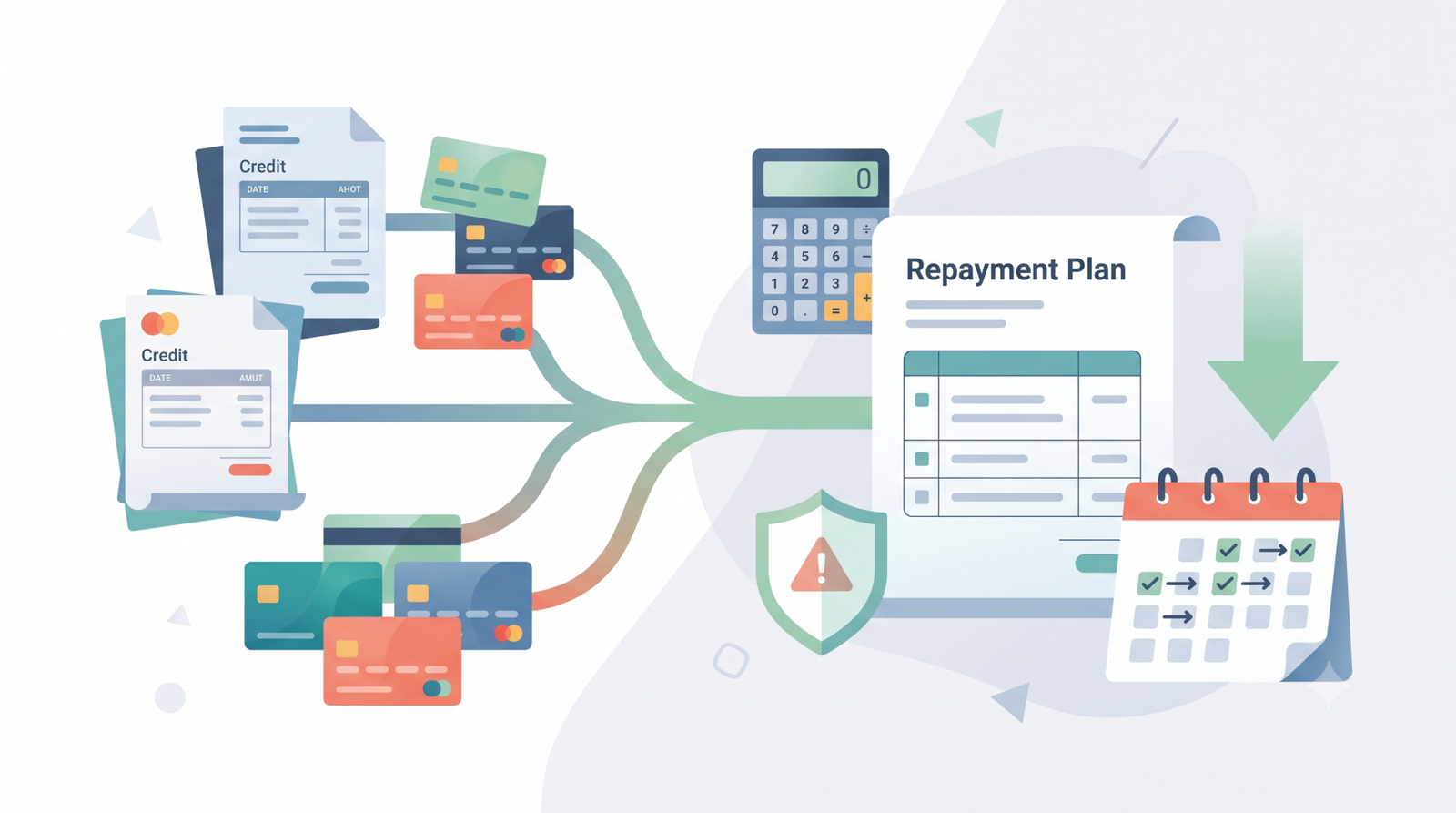
Managing several debts can be exhausting.
You may have different:
- Interest rates
- Minimum payments
- Due dates
- Lenders
- Account terms
- Fees
- Repayment periods
Debt consolidation combines multiple debts into one account or payment. The goal may be to simplify repayment, lower the interest cost, or create a clearer timeline.
But consolidation is not automatically a solution.
A new loan or balance-transfer account can reduce the number of payments while still costing more overall. A lower monthly payment may result from a longer repayment term. Some products also involve fees, variable rates, or the loss of protections attached to the original debt.
This guide explains when debt consolidation may help, the advantages and disadvantages, how to compare the total cost, what risks to watch for, and what questions to ask before accepting an offer.
Debt products and consumer protections vary by country, lender, and borrower. This article is general education, not personalized debt advice.
What Is Debt Consolidation?
Debt consolidation means combining multiple debts into one new repayment arrangement.
You may consolidate through:
- A personal loan
- A balance-transfer credit card
- A home-secured loan or credit line
- A debt-management plan
- A lender’s internal restructuring program
- Another financial product
The new arrangement may be used to pay several existing creditors. Instead of making multiple payments, you make one payment to the new provider.
The original debts may be:
- Closed
- Paid off
- Transferred
- Restricted
- Replaced by the new account
The exact result depends on the product and agreement.
Consolidation changes how debt is structured. It does not automatically reduce the amount you owe.
Why People Consider Consolidation
People may consider consolidation because they want to:
- Reduce the number of payments
- Lower the interest rate
- Make due dates easier to manage
- Replace variable rates with a fixed rate
- Set a clear repayment date
- Avoid missing payments
- Reduce financial stress
- Stop using several revolving accounts
These goals can be reasonable.
However, the advertised benefit may focus only on the monthly payment. A lower payment can result from a longer term, which may increase the total interest paid.
Always compare the complete cost.
Potential Benefits of Debt Consolidation
One Payment
One payment may be easier to track than several accounts with different dates.
Possible Lower Interest
If the new rate is lower after fees, more of each payment may reduce the principal.
Clear Repayment Schedule
A fixed term may help you see when the debt could be repaid if payments remain current.
Reduced Administrative Stress
Fewer statements and due dates can reduce the chance of forgetting a payment.
Predictable Payments
A fixed-rate product may make monthly planning easier than several variable rates.
Opportunity to Stop Revolving Debt
A structured loan may create a clear endpoint, while a credit card can remain open indefinitely.
These benefits depend on the actual terms and whether you avoid creating new balances.
Potential Disadvantages and Risks
Longer Repayment
A lower monthly payment may extend the debt for several additional years.
Fees
Costs may include:
- Origination fees
- Balance-transfer fees
- Application fees
- Closing costs
- Annual fees
- Early-repayment charges
- Legal or administrative costs
Higher Total Cost
Even a lower interest rate may cost more if the repayment term is much longer.
Variable Rates
A rate that starts low may increase later.
Secured Debt
Using a home or asset as security may put that asset at risk if payments are missed.
New Spending
If you consolidate credit card balances but continue using the cards, you may end up with both a consolidation payment and new balances.
Loss of Protections
Some original loans may have benefits, payment protections, or flexible terms that disappear when replaced.
Credit Effects
Applying for new credit, closing accounts, or missing payments during the transition may affect your credit profile.
A consolidation product should be reviewed as a complete financial commitment, not just a payment reduction.
Compare Total Cost, Not Only Monthly Payment
Before accepting an offer, record:
- New balance
- Interest rate
- Fixed or variable rate
- Monthly payment
- Number of payments
- Fees
- Total repayment
- Early-payment terms
- Late-payment consequences
- Security or collateral
- What happens to old accounts
Use this basic comparison:
| Cost Detail | Existing Debts | Consolidation Offer |
|---|---|---|
| Total balance | ||
| Interest rate | ||
| Monthly payments | ||
| Number of payments | ||
| Total interest | ||
| Fees | ||
| Security required | ||
| Final repayment date |
If the provider will not clearly explain the total cost, do not rush into the agreement.
When Consolidation May Help
Consolidation may be worth considering when:
- The new interest rate is genuinely lower
- Fees are reasonable
- The repayment period is not unnecessarily long
- The monthly payment fits your budget
- You have stopped adding new debt
- The product has clear terms
- You understand what happens to the old accounts
- The new arrangement preserves important protections
- The debt problem is caused partly by complexity
For example, someone with several high-rate balances may benefit from one fixed payment if the new loan has a lower total cost and they stop using the old accounts.
The decision should be based on the complete comparison, not the promise of convenience alone.
When Consolidation May Make Things Worse
Consolidation may create problems when:
- The new rate is only temporarily low
- The repayment term is much longer
- Fees are high
- The debt is secured by an important asset
- The monthly payment is still unaffordable
- New credit card spending continues
- The lender makes unrealistic promises
- You have not addressed the reason the debt grew
- The offer requires upfront fees
- The total repayment is not disclosed
If the underlying spending, income, or emergency problem remains unchanged, consolidation may only move the debt around.
A lower payment does not solve a budget deficit.
Review Your Budget Before Applying
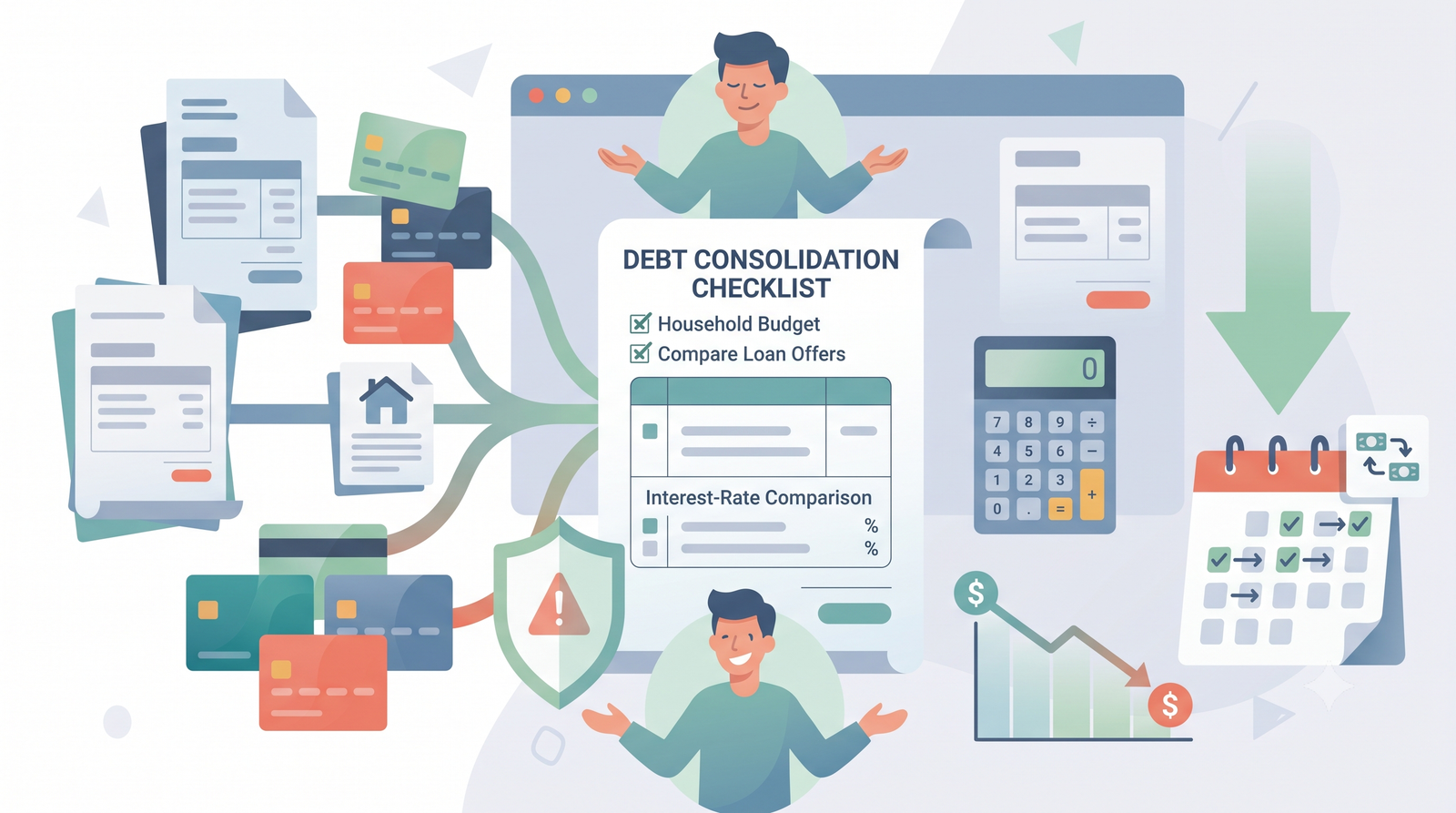
Before applying, calculate whether the new payment fits after:
- Housing
- Food
- Utilities
- Transportation
- Healthcare
- Insurance
- Minimum obligations
- Emergency savings
- Irregular expenses
Ask:
- Why did I accumulate the debt?
- Will consolidation stop new borrowing?
- Can I close or restrict the old accounts?
- What will I do if an emergency occurs?
- Is my income stable?
- Can I pay the new amount during a low-income month?
- Does the plan leave room for basic savings?
If the budget is already short each month, a new loan may not solve the problem. You may need to reduce expenses, increase income, negotiate with creditors, or seek qualified support first.
Balance Transfers
A balance-transfer card may offer a lower introductory rate for a limited time.
Compare:
- Transfer fee
- Promotional period
- Standard rate afterward
- Minimum payment
- Eligibility
- Annual fee
- Payment deadlines
- Consequences of missed payments
Calculate whether you can repay most or all of the transferred balance during the promotional period.
Do not assume the promotional rate will continue indefinitely.
Avoid using the new card for additional purchases if the goal is repayment.
Secured Consolidation Loans
Some consolidation products use a home or another asset as collateral.
This may create a lower rate, but it also increases the consequences of missed payments.
Ask:
- What asset is secured?
- What happens after a missed payment?
- Are there legal or closing costs?
- Is the rate fixed?
- Can the term change?
- What is the total repayment?
- What protections are lost?
A lower rate is not automatically worth placing a major asset at risk.
Nonprofit Debt-Management Plans
A debt-management plan may involve working with a nonprofit counseling organization to create a structured repayment arrangement.
Possible features include:
- One payment
- Negotiated rates
- A defined timeline
- Budget support
- Account restrictions
Ask about:
- Fees
- Creditor participation
- Payment schedule
- Effect on credit
- Account closure
- Total cost
- What happens if a payment is missed
Verify the organization’s reputation and avoid companies that promise immediate debt elimination or guarantee a specific result.
Debt management is different from debt settlement. Understand the service before signing an agreement.
A Realistic Consolidation Example
Suppose someone has:
| Debt | Balance | Rate | Monthly Payment |
|---|---|---|---|
| Credit card A | $3,000 | 25% | $100 |
| Credit card B | $2,000 | 22% | $70 |
| Personal loan | $4,000 | 14% | $150 |
| Total | $9,000 | $320 |
A lender offers a consolidation loan:
- New balance: $9,300 after fees
- Interest rate: 13%
- Term: 48 months
- Monthly payment: $250
- Total repayment: $12,000
The payment is $70 lower, but the borrower must compare the total repayment, fees, and risk.
If the borrower can continue paying $320 per month on the new loan, the debt may be repaid sooner. If the lower payment is used to create new spending, the financial situation may become worse.
The offer should be evaluated using the borrower’s full budget and behavior.
Common Debt Consolidation Mistakes
- Focusing only on the lower payment: The term may be much longer.
- Ignoring fees: Fees increase the amount borrowed.
- Using secured debt casually: Missing payments may put an asset at risk.
- Continuing to use old accounts: New balances can create double debt.
- Failing to check the post-promotion rate: The future cost may be high.
- Not comparing total repayment: Monthly cost is only one measure.
- Accepting unclear terms: Ask for written details.
- Using a consolidation loan to cover a budget deficit: The underlying problem may continue.
- Trusting guaranteed debt relief: Be cautious of aggressive promises.
- Missing payments during the transfer: The old account may still require payment until the process is complete.
Frequently Asked Questions
Is debt consolidation a good idea?
It may help when it reduces total cost, simplifies repayment, and fits your budget. It can make things worse when fees, longer terms, variable rates, or new spending increase the overall burden.
Does debt consolidation reduce the amount I owe?
Usually, it reorganizes debt rather than reducing the principal. Fees may even increase the new balance.
Does consolidation hurt your credit?
Applying for new credit, opening an account, closing old accounts, or missing payments may affect your credit. The effect depends on the product, scoring model, and account history.
Is a lower monthly payment always better?
No. A lower payment may result from a longer repayment period and higher total interest. Compare the full repayment cost.
Should I use a home-secured loan to consolidate debt?
This involves significant risk because an important asset may be used as security. Understand the terms and consequences before considering it.
What is the difference between debt consolidation and debt settlement?
Consolidation generally combines debts into a repayment arrangement. Settlement involves negotiating to pay less than the full amount and can have different credit, legal, tax, and fee consequences.
Can I consolidate credit card debt without closing the cards?
It may be possible, but continuing to use the cards can create new balances. If you keep them open, create strict rules and avoid new borrowing.
What should I do if I cannot afford minimum payments?
Contact creditors early, review essential expenses, seek reputable nonprofit support, and obtain qualified local guidance. Do not ignore the accounts.
Key Takeaways
- Debt consolidation combines several debts into one repayment arrangement.
- It may simplify payments or reduce interest, but it does not automatically reduce the amount owed.
- Compare total repayment, fees, rate, term, security, and payment consequences.
- A lower monthly payment may cost more over time.
- Avoid using secured debt without understanding the risk to your assets.
- Do not continue adding balances after consolidation.
- Review your budget before applying to confirm the new payment is affordable.
- Be cautious of guaranteed debt-relief promises and large upfront fees.
- Readers can continue with debt payoff strategy, how to negotiate a lower interest rate, and why paying off debt feels hard.
- Those concerned about credit history can review how long negative items stay on a credit report.
Debt consolidation can be useful when it creates a clearer, less expensive, and manageable path to repayment. It can be harmful when it only lowers the monthly payment while increasing the total cost or putting important assets at risk.
Compare the complete terms, understand why the debt accumulated, and make sure the new plan prevents the problem from repeating.
This article is for informational purposes only and is not financial advice.
Leave a Reply
You must be logged in to post a comment.