
An employer retirement match can be one of the most valuable benefits connected to a workplace retirement plan.
The basic idea is simple: you contribute money to the plan, and your employer contributes additional money according to the plan’s rules.
But employer matching is often misunderstood.
Employees may not know:
- How much they need to contribute
- Whether the employer matches every contribution
- What “up to” a percentage means
- When matching begins
- Whether the employer contribution is immediately theirs
- What happens if they leave the job
- How plan limits affect contributions
- Whether the match is calculated per paycheck or annually
A match is not free money with no conditions. It is a benefit with specific rules that should be read carefully.
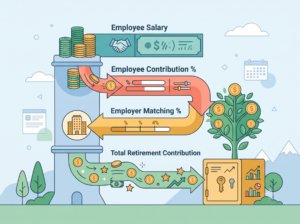 This guide explains how employer 401k matching works, how to read a matching formula, what vesting means, how contribution timing can affect the match, and why failing to receive the full available match may reduce long-term retirement savings.
Plan rules vary by employer and country. The examples use common US-style terminology, but you should rely on your own official plan documents.
What Is an Employer Match?
An employer match is an additional retirement contribution made by your employer when you contribute to an eligible workplace plan.
For example, a plan may say:
The employer matches 50% of employee contributions up to 6% of eligible pay.
This could mean:
- You contribute 6% of pay
- Your employer contributes an additional 3% of pay
- The total retirement contribution becomes 9% of pay
The employer does not necessarily match unlimited contributions.
The formula may differ by plan. It might involve:
- A percentage of your contribution
- A percentage of your salary
- Different rates for different contribution levels
- A fixed contribution
- A yearly contribution
- A discretionary contribution
- A profit-sharing arrangement
Do not assume that every workplace plan matches contributions in the same way.
How to Read a Matching Formula
Suppose your annual salary is $60,000 and the plan says:
Employer matches 100% of contributions up to 4% of pay.
If you contribute 4%:
- Your contribution: $2,400
- Employer contribution: $2,400
- Total contributed: $4,800
If you contribute only 2%:
- Your contribution: $1,200
- Employer contribution: $1,200
- Total contributed: $2,400
The employer contribution is based on the plan formula, not simply on your total salary.
Another plan might say:
Employer matches 50% of contributions up to 6% of pay.
At a $60,000 salary:
- Your contribution at 6%: $3,600
- Employer contribution at 50%: $1,800
- Total contributed: $5,400
Read the exact wording. “Matches up to 6%” does not always mean the employer contributes 6%.
What Does “Up to” Mean?
The phrase “up to” usually identifies the maximum amount the employer will match under the plan.
For example:
100% match on the first 3% and 50% match on the next 2%.
This could mean:
- You contribute 3%, employer contributes 3%
- You contribute another 2%, employer contributes 1%
- Maximum employer contribution: 4%
Contributing 5% may be necessary to receive the full possible match.
If you contribute only 3%, you may receive less than the maximum.
Ask the plan administrator:
- What percentage must I contribute?
- What is the maximum employer contribution?
- Are contributions based on gross or eligible pay?
- Does the match apply to bonuses?
- Does it apply to overtime?
- Is the calculation per paycheck or annual?
- What happens if I contribute more than the match limit?
What Is Vesting?
Vesting refers to how much of the employer’s contribution you are entitled to keep if you leave the job.
Your own contributions are generally treated differently from employer contributions, but the exact rules depend on the plan and local law.
A plan may be:
Immediately Vested
You keep employer contributions as soon as they are made.
Gradually Vested
You gain ownership over time, such as a percentage each year.
Cliff Vested
You become fully vested after completing a specified period.
For example, an employee might keep:
- 25% after one year
- 50% after two years
- 75% after three years
- 100% after four years
The schedule varies. Read the official summary plan description or benefits documents.
Vesting should not be the only reason to remain in a job, but it can matter when comparing the value of leaving now versus staying longer.
What Happens If You Leave the Job?
If you leave an employer, several things may happen:
- Your own contributions remain yours
- Vested employer contributions remain yours
- Unvested employer contributions may be forfeited
- The account may remain in the plan
- You may be able to transfer the balance
- You may be able to withdraw money, subject to rules and possible costs
- You may have other plan options
Do not withdraw retirement money without understanding taxes, penalties, fees, and lost future growth.
Ask the plan administrator about:
- Distribution options
- Rollover options
- Vesting balance
- Deadlines
- Investment choices
- Administrative fees
- Tax consequences
The best option depends on the account, your country, age, employment situation, and financial goals.
How the Match Can Grow Over Time
An employer contribution may be invested alongside your own contributions.
Over many years, the account may benefit from:
- Your contributions
- Employer contributions
- Investment growth
- Reinvested returns
- Additional contributions as your income increases
This connects directly with how compound growth works in retirement accounts.
A match does not guarantee investment growth. Account values can fall, and returns vary. But receiving the full available employer contribution may increase the amount that has an opportunity to grow over time.
The Cost of Missing the Full Match

Suppose your salary is $50,000 and your employer matches 50% of contributions up to 6% of salary.
To receive the full match, you may need to contribute 6%.
If you contribute only 3%:
- Your contribution: $1,500
- Employer contribution: $750
If you contribute 6%:
- Your contribution: $3,000
- Employer contribution: $1,500
The difference in employer contributions is $750 for that year.
Over multiple years, the missed contributions could also represent missed opportunities for investment growth. The exact long-term cost depends on returns, fees, contribution changes, and time.
This does not mean everyone should contribute the maximum possible amount. Essential bills, emergency savings, high-interest debt, and other responsibilities matter.
The important point is to understand what your plan offers before deciding how much to contribute.
Match Timing Can Matter
Some employers calculate matching contributions each paycheck. Others may calculate them annually.
This distinction can matter if you:
- Contribute unevenly
- Receive bonuses
- Max out contributions early
- Change jobs
- Take unpaid leave
- Have irregular pay
- Stop contributing temporarily
Some plans include a year-end adjustment, sometimes called a true-up, to ensure the annual match is calculated correctly. Other plans may not.
Ask:
- Is the match calculated per paycheck?
- Is there an annual true-up?
- What happens if I reach the contribution limit early?
- Do I receive the match during leave?
- Are bonuses eligible?
- What happens if I join midyear?
Do not assume that contributing more early in the year always produces the full annual match.
How to Decide How Much to Contribute
Start by reviewing:
- Essential expenses
- Emergency savings
- High-interest debt
- Employer match formula
- Contribution limits
- Vesting schedule
- Other retirement options
- Tax treatment
- Long-term goals
Many employees first consider contributing enough to receive the full available match, if doing so does not prevent them from covering essential needs.
After that, additional money may be directed toward:
- Emergency savings
- High-interest debt
- Other retirement accounts
- Education
- A home goal
- Family priorities
The right balance depends on your circumstances.
Do not contribute so much that you must borrow for basic expenses. Retirement savings should be part of a complete financial plan.
What If You Cannot Receive the Full Match?
If your income is limited, start with what is realistic.
You may:
- Contribute a smaller amount
- Increase contributions gradually
- Raise the percentage after a salary increase
- Direct part of a bonus toward the plan
- Review your budget
- Reduce optional spending
- Build emergency savings first
- Pay down high-cost debt
Even if you cannot receive the full match today, understanding the formula helps you create a future plan.
A small increase of 1% may be more sustainable than an aggressive contribution that causes financial stress.
A Realistic Employer Match Example
Suppose an employee earns $72,000 per year.
The plan states:
Employer matches 100% of the first 3% and 50% of the next 2%.
The maximum employee contribution needed for the full match is 5%.
Employee Contribution at 3%
- Employee contributes: $2,160
- Employer contributes: $2,160
Employee Contribution at 5%
- Employee contributes: $3,600
- Employer contribution:
- First 3% matched fully: $2,160
- Next 2% matched at 50%: $720
- Total employer contribution: $2,880
At 5%, the employee receives the maximum matching contribution of $2,880 under this example.
The numbers are illustrations only. Actual plans differ in formula, eligibility, vesting, pay definition, and timing.
Common Employer Matching Mistakes
- Not reading the formula: “Up to” does not always mean the employer contributes the same percentage.
- Contributing below the match threshold: You may miss part of the available benefit.
- Ignoring vesting: Unvested employer contributions may not remain yours after leaving.
- Maxing out too early: Some plans may not provide the full annual match without a true-up.
- Forgetting irregular pay: Bonuses or overtime may have different rules.
- Withdrawing early: Taxes, penalties, fees, and lost growth may apply.
- Ignoring fees: A match does not make every investment option suitable.
- Contributing more than the budget allows: Essential needs come first.
- Failing to update after a raise: A higher income may create room for higher contributions.
- Assuming employer plans are identical: Rules vary by employer and country.
Frequently Asked Questions
How does employer 401k matching work?
You contribute to an eligible workplace retirement plan, and your employer contributes according to a stated formula, often up to a percentage of your pay.
What does a 5% employer match mean?
It may mean the employer contributes up to 5% of eligible pay, but the exact formula could require you to contribute more or less. Read the plan documents carefully.
What happens if I do not contribute enough to receive the full match?
You may receive only a partial employer contribution. The exact result depends on the plan’s formula.
What does vested mean?
Vesting determines how much of an employer contribution you are entitled to keep if you leave the job. The schedule varies by plan.
Can I lose employer matching contributions if I change jobs?
You may lose unvested employer contributions, depending on the plan. Your own contributions are generally treated separately, but check the official rules.
Should I contribute enough to receive the full match?
Many employees consider receiving the full available match when their budget allows, but essential expenses, emergency savings, debt, and other priorities should also be considered.
What is a true-up contribution?
A true-up may be an employer adjustment that helps calculate the annual match correctly when contributions vary during the year. Not every plan provides one.
Can employer matching contributions lose value?
Yes. Employer contributions are generally invested according to the plan’s investment choices, and investments can lose value.
Key Takeaways
- Employer matching adds money to a workplace retirement account according to a plan formula.
- Read the exact match percentage, contribution threshold, eligible pay definition, and timing.
- “Up to” a percentage does not always mean the employer contributes that full percentage.
- Vesting determines how much employer money you keep after leaving the job.
- Missing part of the available match may reduce long-term retirement savings.
- Ask whether contributions are calculated per paycheck or annually.
- Check whether a true-up contribution exists.
- Do not contribute more than your budget can support.
- Review fees, investment choices, tax rules, and withdrawal conditions.
- Readers can continue with compound growth in retirement accounts, why people underestimate retirement needs, and lifestyle creep and retirement savings.
An employer match can be a valuable part of a workplace benefits package, but its value depends on the rules. Take time to understand how much you need to contribute, when the employer contributes, what becomes vested, and how the account is invested.
A small increase in contributions may help you receive more of an available benefit, but retirement saving should still fit within a complete budget that protects essential needs and current financial stability.
This article is for informational purposes only and is not retirement or investment advice.
Leave a Reply
You must be logged in to post a comment.