
Realizing that you may not have saved enough for retirement can be uncomfortable.
You may feel:
- Regret about waiting
- Anxiety about the future
- Confusion about how much to save
- Pressure to make up for lost time quickly
- Fear that the goal is no longer possible
Starting retirement savings late can make the plan more challenging, but it does not mean that progress is pointless.
You still have choices. You can review your actual needs, increase contributions when possible, use workplace benefits, reduce unnecessary costs, adjust your timeline, and create a plan that reflects your current situation.
This guide explains how to catch up on retirement savings after a late start, how to assess your current position, prioritize contributions, use employer matching, reduce lifestyle creep, manage debt, and make realistic adjustments without relying on extreme promises.
Retirement account rules, contribution limits, taxes, and benefits vary by country and plan. This article is general education, not personalized retirement advice.
First, Do Not Panic
A late start may reduce the time available for compound growth, but panic can lead to poor decisions.
Avoid:
- Taking excessive investment risk
- Investing emergency savings
- Borrowing money to invest
- Following “get rich quickly” promises
- Making major changes without understanding them
- Assuming one calculation determines your entire future
The first step is to replace uncertainty with information.
Gather:
- Retirement account balances
- Workplace plan details
- Employer contributions
- Other savings
- Expected public benefits
- Pension information
- Current income
- Regular expenses
- Debt balances
- Target retirement age
Your current position is a starting point, not a final result.
Estimate What You May Need
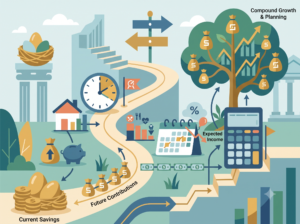
Before deciding how much to save, estimate future needs.
Consider:
- Housing
- Food
- Transportation
- Healthcare
- Insurance
- Taxes
- Home maintenance
- Travel
- Family support
- Debt
- Long-term care
- Personal activities
Then identify possible income sources:
- Public retirement benefits
- Workplace pensions
- Retirement accounts
- Investments
- Rental income
- Part-time work
- Business income
- Other savings
The goal is not to create a perfect prediction. It is to understand the likely gap between future expenses and income.
Read why people underestimate retirement needs for common planning blind spots.
Calculate the Contribution Gap
A basic planning calculation is:
Estimated retirement target − current retirement savings = remaining gap
Then consider:
- Years until retirement
- Monthly contributions
- Employer contributions
- Potential investment growth
- Fees
- Inflation
- Taxes
- Income changes
Online calculators can help illustrate different scenarios, but the results depend on assumptions.
Try several scenarios:
- Current contributions
- A modest contribution increase
- A larger contribution increase
- Working longer
- Reducing future expenses
- Delaying retirement
- Increasing employer contributions
- A combination of these
Do not treat a calculator’s result as a guarantee. Use it to compare choices and identify which changes may matter most.
Capture the Full Employer Match
If your workplace offers a retirement match, understand the formula and contribute enough to receive the full available amount when your budget allows.
Check:
- Required employee contribution
- Maximum employer contribution
- Vesting schedule
- Eligible pay
- Contribution timing
- Annual limits
- What happens after leaving the job
- Investment fees
Read how employer matching works for a detailed explanation.
An employer contribution can increase the amount entering your retirement account without requiring the same amount from your income.
Do not contribute so much that you cannot pay essential bills, high-interest debt, or emergency costs. A match is valuable, but it should fit into a stable financial plan.
Increase Contributions Gradually
A sudden increase may be difficult to maintain.
Instead, try:
- Increasing contributions by 1%
- Raising the amount after each pay increase
- Directing half of a bonus to retirement
- Adding a fixed amount each year
- Increasing contributions after paying off debt
- Saving more after a major expense ends
Small increases can become meaningful when repeated over time.
If your income changes, review your contribution level rather than assuming the old amount still fits.
Reduce Lifestyle Creep

If retirement savings need to increase, review recurring expenses.
Focus on:
- Housing
- Transportation
- Subscriptions
- Dining out
- Travel
- Personal services
- Shopping
- Debt payments
You do not need to remove every enjoyable expense. Choose a few categories that provide less value than the retirement security they are replacing.
When income rises, direct part of the increase toward retirement before lifestyle costs expand.
Read lifestyle creep and retirement savings for practical strategies.
Review Debt Alongside Retirement Savings
High-interest debt can compete with retirement contributions.
List:
- Balance
- Interest rate
- Minimum payment
- Fees
- Repayment timeline
You may need to balance:
- Capturing employer matching contributions
- Building emergency savings
- Paying down high-cost debt
- Increasing retirement contributions
There is no universal order for every household.
Avoid investing more aggressively simply to compensate for delayed savings while expensive debt continues to grow. Review the full cost of borrowing and consider whether reducing high-interest debt would improve your financial position.
The debt payoff strategy guide explains different approaches.
Consider Working Longer or Part-Time
Working longer may provide:
- More contribution years
- Additional employer matching
- More time for investments to grow
- Fewer years relying on savings
- Continued health or workplace benefits
- A larger public benefit in some systems
Part-time work may also provide income and structure after full-time employment ends.
This is not always possible. Health, caregiving, job conditions, and family responsibilities matter.
Treat working longer as one possible planning lever, not as a promise. Build a plan that includes alternatives if work ends earlier than expected.
Consider Reducing Future Expenses
A lower retirement budget may reduce the amount you need to accumulate.
Possible changes include:
- Smaller housing
- Lower transportation costs
- Fewer recurring subscriptions
- A simpler travel plan
- Reduced debt
- Relocation
- Lower household expenses
- Part-time work
- Shared living arrangements
Reducing future expenses should be based on your actual preferences and circumstances. Do not assume that a lifestyle you would dislike will automatically be sustainable.
A realistic lower-cost retirement may be more useful than an unrealistic target based on current high spending.
Review Your Investment Risk Carefully
A late start may create pressure to seek higher returns.
Avoid assuming that taking more risk will automatically solve the gap.
Higher-risk investments may experience:
- Larger losses
- Greater volatility
- Concentration
- Emotional pressure
- Poor timing
- Permanent loss
- Difficulty recovering near retirement
Your investment approach should reflect:
- Time horizon
- Income
- Emergency savings
- Debt
- Risk capacity
- Dependents
- Retirement timeline
- Need for future withdrawals
Do not invest money needed for immediate expenses. Consider qualified advice if your situation is complex or the retirement gap is significant.
Use Catch-Up Contributions Where Available
Some retirement systems allow older workers to contribute additional amounts after reaching a certain age.
Rules may apply to:
- Contribution limits
- Employer plans
- Individual accounts
- Income
- Account type
- Tax treatment
- Timing
Check your official plan documents or government resources for current rules.
Do not rely on outdated online limits. Contribution rules can change, and different accounts may have different conditions.
Create an Annual Retirement Review
Review your plan once or twice a year.
Check:
- Current balance
- Contributions
- Employer matching
- Fees
- Investment choices
- Beneficiaries
- Retirement date
- Expected expenses
- Debt
- Emergency savings
- Public benefits
- Insurance
Make one or two adjustments at a time.
A review should improve the plan without encouraging constant trading or emotional changes.
A Realistic Late-Start Example
Suppose someone is age 45 with:
- $80,000 in retirement savings
- $70,000 annual income
- Employer match available
- $8,000 in high-interest debt
- Twenty years before their preferred retirement age
They decide to:
- Contribute enough to receive the available employer match
- Increase contributions after paying off the high-interest debt
- Direct half of future raises toward retirement
- Build a small emergency fund
- Reduce transportation and subscription costs
- Review retirement needs annually
- Consider working part-time for a period after full-time employment
This plan may not produce the same result as starting at age 25, but it creates several ways to improve the future outcome.
The exact result depends on contributions, fees, taxes, investment returns, inflation, and retirement timing.
Common Late-Start Retirement Mistakes
- Panic investing: Taking excessive risk can create larger losses.
- Ignoring employer matching: You may miss available contributions.
- Using emergency savings: Retirement money should not replace essential reserves.
- Assuming one income source is enough: Review benefits, accounts, and other resources.
- Ignoring high-interest debt: Borrowing costs can undermine retirement saving.
- Expecting a calculator to predict the future: Projections depend on assumptions.
- Increasing lifestyle costs after raises: Extra income may be needed for future goals.
- Avoiding retirement planning because it feels late: Delay reduces available choices.
- Forgetting healthcare and inflation: Future expenses may be higher than expected.
- Making extreme cuts without a plan: Unsustainable restrictions often fail.
Frequently Asked Questions
Can I still retire comfortably if I started saving late?
It may still be possible, but the answer depends on savings, income, expenses, debt, retirement age, benefits, and future spending. Review the numbers and create multiple scenarios.
How can I catch up on retirement savings?
Capture employer matching, increase contributions gradually, direct part of raises and bonuses toward savings, reduce lifestyle creep, manage high-interest debt, and review whether working longer is possible.
Should I invest more aggressively because I started late?
Not automatically. Higher risk can produce larger losses. Your investment approach should match your timeline, financial situation, and ability to handle volatility.
Should I pay off debt or save for retirement?
The right balance depends on employer matching, debt interest, emergency savings, income stability, and other responsibilities. Avoid ignoring high-cost debt or essential savings.
How much should I contribute after age 50?
Rules vary by plan and country. Check current official contribution limits and any catch-up provisions available to you.
Is working longer a good retirement strategy?
Working longer may provide more income, contributions, and time for savings to grow, but health and employment conditions matter. Consider it one option among several.
Should I reduce my retirement lifestyle goal?
You may choose to reduce expenses, delay retirement, relocate, or work part time. The goal is to create a realistic plan that reflects your preferred life.
How often should I review retirement savings?
Review at least annually and after major changes in income, debt, health, family responsibilities, or retirement timing.
Key Takeaways
- Starting retirement savings late can make planning more challenging, but progress is still possible.
- Begin with accurate information about current savings, expenses, income, debt, and benefits.
- Estimate future needs instead of relying on fear or a single target number.
- Capture available employer matching contributions when your budget allows.
- Increase contributions gradually after raises, bonuses, or debt repayment.
- Reduce lifestyle creep without eliminating every meaningful expense.
- Review high-interest debt and emergency savings alongside retirement contributions.
- Consider working longer, reducing future costs, or using part-time income as possible planning options.
- Avoid excessive investment risk simply to compensate for lost time.
- Readers can continue with compound growth in retirement accounts, employer matching, and why people underestimate retirement needs.
- A clear debt payoff strategy may also improve long-term retirement flexibility.
A late start may change the plan, but it does not eliminate the value of taking action now. Review your actual position, focus on the changes within your control, and build a strategy that combines savings, spending, debt management, and realistic timing.
You do not need to solve the entire retirement gap in one decision. Start with the next useful step and review the plan regularly as your financial situation develops.
This article is for informational purposes only and is not retirement or investment advice.
Leave a Reply
You must be logged in to post a comment.