Bad credit can make ordinary financial decisions more expensive and stressful. You may have difficulty qualifying for a loan, face higher interest charges, need a larger deposit for housing, or feel uncertain whenever someone checks your credit history.
The good news is that credit can improve. The less encouraging news is that there is no legitimate overnight solution.
Repairing credit usually involves a combination of:
- Correcting inaccurate information
- Paying bills on time
- Reducing credit balances
- Managing existing accounts carefully
- Avoiding new problems
- Allowing positive information to build over time
The exact timeline depends on what caused the damage, how recent the problems are, what information appears on your reports, and how consistently you manage credit going forward.
This guide explains how to repair bad credit in practical steps, what progress may look like during the first few months, which mistakes to avoid, and why companies promising instant credit repair deserve caution.
This article is educational. Credit rules, reporting periods, and available resources vary by country, so check the official agencies and regulations where you live.
What Does “Bad Credit” Mean?
Bad credit generally means that your credit history contains information suggesting a higher risk to lenders or service providers.
Possible causes include:
- Missed or late payments
- High credit card balances
- Accounts in collections
- Defaults
- Repossessions
- Bankruptcy
- Too many recent applications
- Errors or identity theft
- A short or limited credit history
Credit scoring models may use different calculations, so there is no single universal definition of bad credit.
A low score is not a permanent identity. It is a result of information in your credit history at a particular time. As newer, positive information is reported and older problems become less influential, your credit profile may improve.
Credit scores are usually based on information in credit reports. That means repairing credit begins with understanding what is actually being reported.
How Long Does Credit Repair Take?
There is no fixed credit repair timeline.
Some improvements may appear within a few reporting cycles if you correct an error or lower a high balance. Other problems may take much longer, especially when they involve repeated missed payments, defaults, collections, or bankruptcy.
A general pattern may look like this:
First 30 Days
You can:
- Obtain and review your credit reports
- Identify incorrect accounts
- Set up payment reminders
- Stop applying for unnecessary credit
- Create a plan for overdue balances
- Contact creditors about current problems
Two to Six Months
You may begin to see progress if you:
- Pay accounts consistently
- Reduce revolving balances
- Correct reporting errors
- Avoid new late payments
- Keep applications limited
Six to Twelve Months
A consistent payment record may become more visible. However, the effect depends on the seriousness and age of earlier problems.
Longer Term
Major negative information may continue to affect your history for years, but its influence can lessen as it becomes older and is followed by more positive behavior.
These are general patterns, not promises. A credit score can change differently depending on the scoring model and the information being reported.
Step 1: Get and Review Your Credit Reports
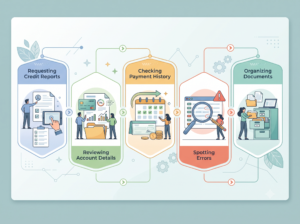
Request your credit reports from the official reporting agencies available in your country.
Review:
- Personal information
- Open accounts
- Closed accounts
- Payment history
- Current balances
- Credit limits
- Collection accounts
- Public records where applicable
- Recent inquiries
- Accounts you do not recognize
Look for:
- Late payments you believe were paid on time
- Accounts that belong to someone else
- Duplicate debts
- Incorrect balances
- Wrong dates
- Accounts listed as open after being closed
- Identity theft
- Information that is too old to remain reportable under local rules
Make a list of every issue and gather supporting documents such as:
- Bank statements
- Receipts
- Payment confirmations
- Account letters
- Screenshots
- Correspondence with creditors
For US readers, the Consumer Financial Protection Bureau explains that consumers can dispute inaccurate information with the credit reporting company and the business that supplied the information. Keep copies of everything submitted.
Step 2: Dispute Inaccurate Information
You generally cannot remove accurate negative information simply because it hurts your score. However, inaccurate or incomplete information should be investigated and corrected.
A dispute should clearly explain:
- Which account contains the error
- What information is incorrect
- Why it is incorrect
- What correction you are requesting
- Which documents support your position
Send copies rather than original documents and keep a record of the submission date.
You may need to contact both:
- The credit reporting agency
- The creditor or company that supplied the information
Follow up according to the process in your country. If the issue is not resolved, a consumer protection agency or qualified adviser may explain additional options.
Do not dispute information that you know is accurate simply to delay repayment or make it disappear. False disputes can create additional problems.
Step 3: Stop New Damage
Before focusing on improving your score, stop the behavior causing further damage.
Create a system for all required payments:
- Calendar reminders
- Automatic payments
- Text or email alerts
- A separate bills account
- A written payment checklist
Automatic payments can help, but check that enough money is available to avoid overdraft fees.
If you cannot pay a bill, contact the creditor before the due date. Ask about hardship options, payment arrangements, or changes to the account. Do not assume that ignoring the account will make the problem disappear.
The most important goal is often to create a new record of on-time payments.
Step 4: Reduce High Credit Balances
High balances can affect credit scoring, especially when they use a large portion of available revolving credit.
Start by listing:
- Current balance
- Credit limit
- Interest rate
- Minimum payment
- Due date
Then create a repayment plan that fits your budget.
Possible approaches include:
- Paying extra toward the highest-interest balance
- Paying the smallest balance first for motivation
- Stopping new charges
- Reducing optional spending
- Applying extra income
- Requesting a lower-cost repayment arrangement
Do not empty your emergency savings or skip essential bills simply to reduce a credit balance quickly. A plan that creates a new crisis may not improve your overall financial position.
As balances decline, continue making payments on time. A lower balance is helpful, but consistent management matters too.
Step 5: Deal With Collections Carefully
If an account is in collections, confirm the details before making payment.
Check:
- The original creditor
- Amount claimed
- Account history
- Date of the debt
- Whether the collector is legitimate
- Whether the debt is already paid or disputed
- Local rules about collection and reporting
Keep records of all communication.
Before agreeing to a payment arrangement, understand:
- Total amount
- Number of payments
- Fees
- Interest
- What will be reported
- What happens after final payment
- Whether you receive written confirmation
Do not provide sensitive information to an unknown caller without verifying the company.
If the debt is disputed, seek appropriate local consumer or legal guidance. Rules about collections, reporting, and limitation periods vary by location.
Step 6: Be Careful With New Credit Applications
Applying for several accounts in a short period can create additional inquiries and may signal financial stress to lenders.
Before applying, ask:
- Do I genuinely need this account?
- Can I manage another payment?
- What fees and interest apply?
- Will the application involve a hard inquiry?
- Is there a safer alternative?
- Am I applying because I need credit or because I want a quick score increase?
Checking your own credit report or score generally does not have the same effect as a lender’s hard inquiry, but the rules and scoring treatment can vary.
Do not open several accounts simply to create a better credit mix. New credit should have a clear purpose and fit your budget.
Step 7: Keep Older Accounts Open Only When Appropriate
Closing an account can sometimes change the average age of your accounts, available credit, or payment history.
However, keeping an account open is not always the right decision.
Consider:
- Annual fees
- Whether the account encourages overspending
- Whether you can manage it safely
- Whether closing it affects your available credit
- Whether the account is causing financial stress
If an account has no fee and you can keep it inactive responsibly, leaving it open may be reasonable. If it creates a temptation to borrow, closing it may protect your finances.
Credit improvement should support your overall financial health, not only a score.
A Realistic Credit Repair Timeline
Consider someone with:
- Two late payments
- A credit card balance using most of its available limit
- One reporting error
- No recent savings buffer
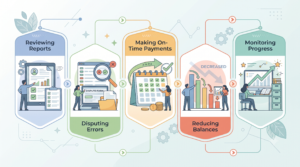
During the first month, they review reports, dispute the error, set up payment alerts, and stop using the card for new purchases.
Over the next several months, they:
- Pay every account on time
- Reduce the credit card balance gradually
- Avoid unnecessary applications
- Build a small emergency fund
- Check that the disputed error was investigated
The score may not rise dramatically immediately. However, the person is improving the information that future scoring calculations will use.
After six to twelve months of consistent behavior, the profile may look more stable. The exact score change will depend on the original problems, scoring model, and information reported by creditors.
The important lesson is that credit repair is usually a process of replacing damaging patterns with consistent ones.
Credit Repair Scams to Avoid
Be cautious of companies that promise:
- A specific score increase in a few days
- Removal of all negative information
- A new credit identity
- Guaranteed approval
- Deletion of accurate late payments
- Instant results for an upfront fee
- Instructions to dispute information you know is correct
Accurate negative information generally cannot be removed simply because it is unfavorable. In the US, the Federal Trade Commission warns consumers about companies that make these promises or advise people to use false information.
You can review your own reports and dispute genuine errors without paying a company to do something you can do yourself.
A legitimate nonprofit credit counselor may help with budgeting or debt-management education, but always check fees, services, and reputation before sharing personal information.
Common Credit Repair Mistakes
- Expecting overnight results: Credit history usually improves through consistent behavior over time.
- Disputing accurate information: False disputes can create new problems.
- Ignoring current payments: Old problems cannot be repaired while new late payments continue.
- Closing every account: Closing accounts may affect available credit or account age.
- Applying for many products: New applications may add inquiries and obligations.
- Using more debt to improve credit: Borrowing unnecessarily can worsen financial stress.
- Paying a scam company upfront: Be cautious of guarantees and large advance fees.
- Ignoring credit reports: You cannot correct information you never review.
- Focusing only on the score: Payment reliability, debt levels, and financial stability matter too.
- Using emergency savings to make unrealistic payments: A sustainable plan is better than a short-term extreme effort.
Frequently Asked Questions
How quickly can I repair bad credit?
Some changes may appear after one or more reporting cycles, especially when an error is corrected or a high balance is reduced. More serious problems may take many months or longer to improve.
Can accurate late payments be removed?
Usually, accurate information cannot be removed simply because it is negative. You can dispute information that is inaccurate, incomplete, duplicated, or reported incorrectly.
Does paying off debt improve my credit score immediately?
Not always. The account may need to update with the reporting agencies, and other factors may affect the score. Paying debt can still improve your overall financial position even if the score does not change instantly.
Can a credit repair company fix my credit faster?
No company can legitimately guarantee that accurate negative information will disappear quickly. Be cautious of promises involving instant score increases, new identities, or deletion of truthful information.
Should I close credit cards after paying them off?
It depends on fees, spending behavior, account age, available credit, and personal circumstances. Closing an account may affect your credit profile, but keeping an account open is not worth it if it encourages unaffordable borrowing.
Should I pay collections before other debts?
The right priority depends on the debt, interest, legal status, reporting, and your budget. Verify the account and consider qualified local advice before making an arrangement.
Can I repair bad credit without borrowing more money?
Yes. Reviewing reports, correcting errors, paying existing accounts on time, reducing balances, and avoiding new problems are core parts of rebuilding credit.
What is the first thing to do when repairing credit?
Get and review your credit reports. You need to know which information is accurate, which items are damaging, and whether any errors require a dispute.
Key Takeaways
- Credit repair is a process, not an overnight service.
- Start by reviewing your credit reports for errors, duplicate accounts, and unfamiliar activity.
- Dispute inaccurate information with the relevant reporting agency and information provider.
- Stop new damage by paying bills on time and creating payment reminders.
- Reduce high revolving balances gradually and avoid taking on unnecessary new debt.
- Verify collection accounts before making payments or agreements.
- Be cautious with new credit applications and companies promising instant results.
- Accurate negative information may remain for a period determined by local rules, but its effect can lessen as newer positive information appears.
- A realistic timeline may involve several months of consistent payments and careful account management.
- Readers can continue with how credit scores work, why credit scores drop, and hard inquiries versus soft inquiries.
- Those managing several balances can also review debt payoff strategy.
Bad credit does not have to define your financial future. The repair process begins with accurate information and continues through ordinary decisions: paying on time, reducing balances, avoiding unnecessary applications, and giving the process enough time to work.
There may not be a shortcut, but a consistent plan can create measurable progress. Focus on the next correct action rather than searching for a perfect or instant solution.
This article is for informational purposes only and is not financial advice.
Leave a Reply
You must be logged in to post a comment.