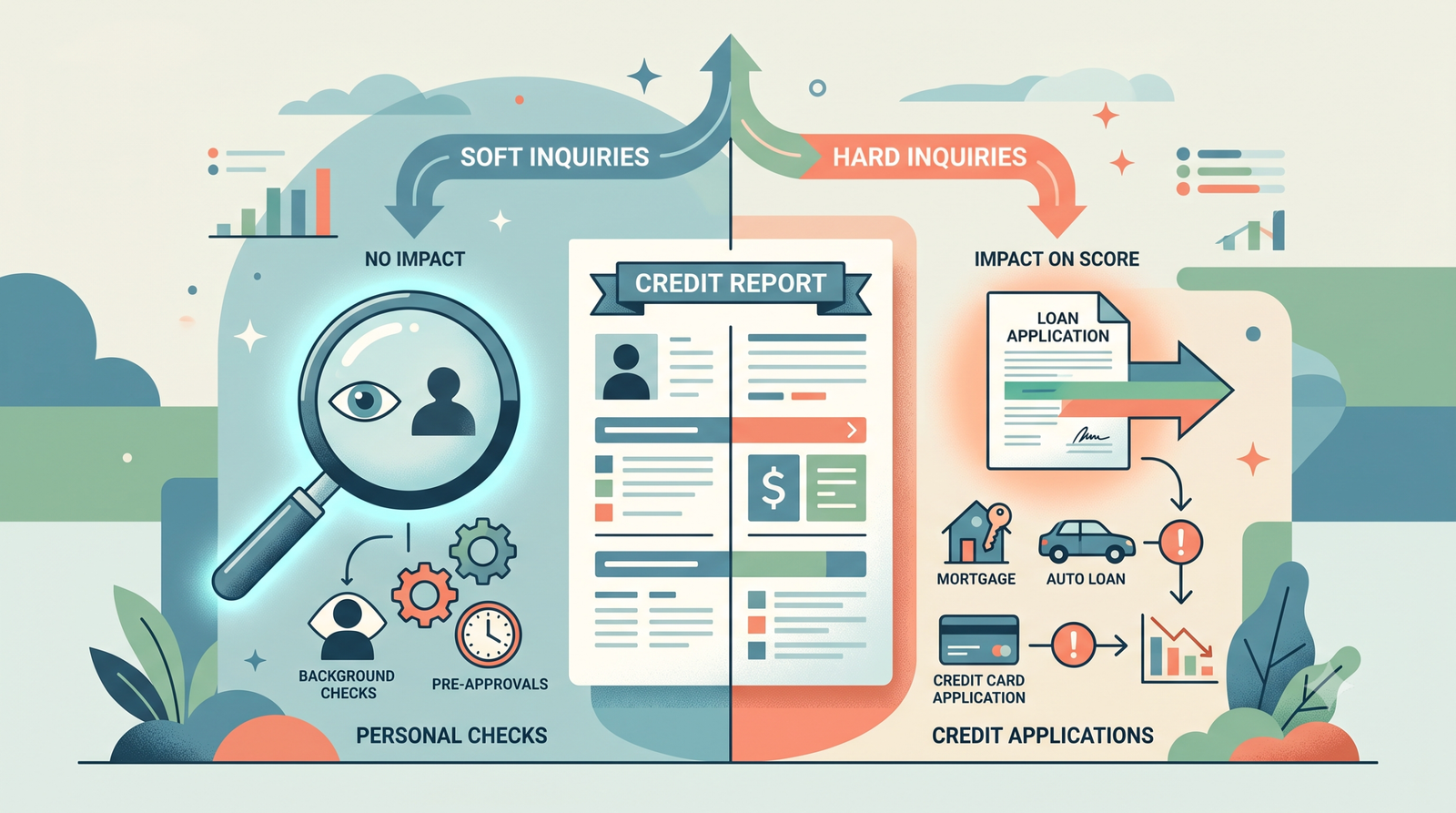
Checking your credit can feel risky when you are trying to improve your financial profile. You may worry that viewing your own report, comparing loan offers, or applying for a new account will lower your score.
The confusion usually comes from two different types of credit checks:
- Hard inquiries
- Soft inquiries
They are not treated the same way.
A soft inquiry is generally connected to checking or reviewing credit information and usually does not affect the score used by lenders. A hard inquiry usually happens when a lender checks your credit after you apply for credit, and it may affect your score for a limited period.
This guide explains hard inquiry vs soft inquiry in plain English, including what causes each type, whether checking your own credit hurts your score, how applications affect your report, and what to do if you see an inquiry you do not recognize.
Credit rules and scoring models vary by country and provider, so treat examples as general education rather than personal credit advice.
What Is a Credit Inquiry?
A credit inquiry is a record that someone accessed your credit report or credit-related information.
The inquiry section of a credit report may show:
- Who accessed the report
- When the access occurred
- Whether it was related to an application
- Which type of inquiry was recorded
- Whether the inquiry may be visible to lenders
The presence of an inquiry does not automatically mean that your credit is damaged. Its meaning depends on the type.
Credit inquiries are only one part of a credit profile. Payment history, balances, account age, types of credit, and other information may have a larger effect depending on the scoring model.
You should not avoid checking your credit because you are afraid of inquiries. Reviewing your own report can help you identify inaccurate information, possible fraud, and accounts that need attention.
What Is a Soft Inquiry?
A soft inquiry, sometimes called a soft pull, is generally an access to your credit information that is not connected to a formal application for new borrowing.
Common examples may include:
- Checking your own credit report
- Checking your own credit score
- A lender viewing information for a prequalification
- An existing creditor reviewing your account
- An employer check where permitted and authorized
- An insurance-related check in some situations
- A background or identity-verification process
- A promotional review by a creditor
Soft inquiries usually do not affect the credit score that lenders use.
They may still appear on a version of your credit report that you can see, but lenders may not see them in the same way as hard inquiries.
The exact rules depend on the country, reporting agency, purpose of the check, and type of credit product. Read the disclosure before authorizing a credit check.
What Is a Hard Inquiry?
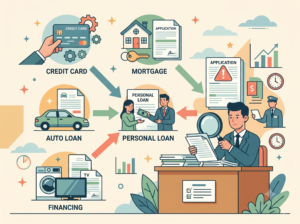
A hard inquiry, sometimes called a hard pull, usually occurs when a lender checks your credit after you apply for a credit product.
Examples may include applications for:
- Credit cards
- Auto loans
- Mortgages
- Personal loans
- Student financing
- Lines of credit
- Retail financing
- Some rental or service arrangements
A hard inquiry may slightly lower a score for a limited period. The effect is usually one part of the overall scoring calculation, but multiple applications in a short time can become more noticeable.
A hard inquiry is not the same as being rejected. An application may be approved or declined, and the inquiry may still be recorded.
Before applying, ask whether the provider will perform a hard or soft inquiry. Some companies use a soft inquiry for an initial eligibility check and a hard inquiry only after you formally apply.
Does Checking My Own Credit Hurt It?
Generally, checking your own credit report or score is treated as a soft inquiry and does not lower the score used by lenders.
This is one reason regular credit monitoring can be useful. You need to know what is being reported so you can identify:
- Incorrect balances
- Late payments reported in error
- Accounts you do not recognize
- Duplicate accounts
- Fraud
- Old information
- Unauthorized applications
Checking your own credit is different from authorizing a lender to evaluate you for a new account.
If a website asks for permission to check your credit, read the wording carefully. A “check your rate” service may use a soft inquiry, but submitting a full application may result in a hard inquiry.
When uncertain, ask directly:
Will this check be recorded as a hard inquiry or a soft inquiry?
Also ask whether the check will happen now or only after you submit a formal application.
Do Multiple Loan Applications Count Separately?
Credit scoring systems may treat several applications for the same type of loan differently from several unrelated applications.
For example, people often compare rates for:
- Mortgages
- Auto loans
- Student loans
Some scoring models may group multiple inquiries for the same type of loan within a limited shopping period. The exact time window and treatment can vary by scoring model.
This does not mean you should submit unlimited applications. Compare lenders carefully, understand the timing, and avoid applying for unrelated credit products at the same time.
For example, applying for several credit cards, a personal loan, and an auto loan in one short period may create a different pattern from comparing several auto-loan offers.
Ask lenders about prequalification options first when available.
How Long Do Hard Inquiries Stay?
The inquiry may remain visible on a credit report longer than the period during which it affects a score.
In many credit-reporting systems, a hard inquiry can remain listed for up to two years, while its scoring effect may be shorter. The exact period depends on the reporting agency, scoring model, and country.
The inquiry is usually not the same as a missed payment, default, or collection account. It is a record that a lender accessed your credit in connection with an application.
A hard inquiry alone generally does not indicate that you are unable to manage credit. Lenders may consider the overall pattern, including:
- Payment history
- Current balances
- Income
- Existing debt
- Number of new accounts
- Length of credit history
- Type of credit requested
This is why one inquiry should not be treated as a financial disaster.
How to Limit Unnecessary Hard Inquiries
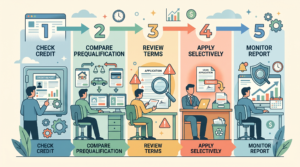
1. Check Your Credit First
Review your report and score before applying. This helps you understand whether the application is realistic.
2. Compare Requirements
Different lenders may have different income, debt, and credit requirements. Research before submitting an application.
3. Use Prequalification Carefully
Prequalification may use a soft inquiry, but confirm the provider’s process and read the terms.
4. Apply Only When You Need the Account
Do not apply simply because a promotion or advertisement appears attractive.
5. Avoid Submitting Many Unrelated Applications
Choose the most suitable product after comparing options.
6. Read the Disclosure
Look for language explaining whether the provider will use a hard inquiry.
7. Keep Records
Note when you applied and which provider accessed your report. This makes unfamiliar inquiries easier to investigate later.
What If You See an Inquiry You Do Not Recognize?
An unfamiliar inquiry does not always mean fraud. It may result from:
- A lender using another company name
- A retail financing partner
- An application you forgot
- A prequalification process
- An existing creditor review
- Identity theft
- A reporting error
Start by checking the date, company name, and recent activity.
If you still do not recognize it:
- Contact the company listed.
- Ask why your report was accessed.
- Review your credit reports for unfamiliar accounts.
- Dispute inaccurate information with the relevant reporting agency.
- Consider identity-protection steps available in your country.
- Keep records of your communication.
If you suspect identity theft, act quickly. Contact the relevant financial institutions and consumer-protection agencies for guidance.
An unfamiliar inquiry should be investigated, but do not panic before confirming what caused it.
Hard Inquiries vs Soft Inquiries: Quick Comparison
| Feature | Hard Inquiry | Soft Inquiry |
|---|---|---|
| Common purpose | Formal credit application | Review, monitoring, prequalification, or existing-account check |
| Usually affects score? | May have a small temporary effect | Generally does not |
| Common examples | Credit card, loan, mortgage, financing application | Checking your own score, prequalification, account review |
| Usually visible to lenders? | Often visible | Usually not treated the same way |
| Should you monitor it? | Yes | Yes, especially if unfamiliar |
| Is it automatically bad? | No | No |
The table is a general guide. The treatment can vary according to the reporting agency, scoring model, lender, and local rules.
A Realistic Example
Imagine someone is shopping for a car loan.
They first check their own credit report and score. This is generally a soft inquiry.
They then use two lenders’ prequalification tools. Both lenders explain that they use soft checks during the initial comparison.
After choosing the most suitable offer, the person submits one formal loan application. That application creates a hard inquiry.
This approach gives the person information before applying and limits unnecessary applications.
By contrast, submitting applications to ten unrelated lenders without checking eligibility could create a more complicated inquiry pattern and several new credit obligations if multiple applications are approved.
The lesson is not to avoid all credit applications. It is to compare carefully, understand the process, and apply selectively.
Common Mistakes About Credit Inquiries
- Avoiding your own credit report: Checking your own credit is generally not treated like a lender’s hard inquiry.
- Assuming every “rate check” is soft: Confirm the provider’s process before submitting information.
- Applying for many accounts at once: Multiple applications may create unnecessary inquiries and obligations.
- Confusing an inquiry with a new account: An inquiry shows access; it does not necessarily mean a new account was opened.
- Panicking over one inquiry: One inquiry is only one part of a larger credit profile.
- Ignoring an unfamiliar inquiry: Investigate it promptly in case it is an error or fraud.
- Focusing only on inquiries: Payment history and balances may matter more to your overall profile.
- Applying before checking affordability: A credit application should fit your budget, not only your score.
- Assuming prequalification guarantees approval: A soft-check result may not be the final lending decision.
- Not reading disclosures: The terms usually explain how the credit check will be handled.
Frequently Asked Questions
Does checking my own credit hurt my score?
Generally, no. Checking your own credit report or score is usually treated as a soft inquiry and does not lower the score used by lenders.
What is the difference between a hard inquiry and a soft inquiry?
A hard inquiry is generally connected to a formal credit application and may have a small temporary effect. A soft inquiry is usually connected to monitoring, prequalification, or an existing account and generally does not affect the score.
How many hard inquiries are too many?
There is no universal number. The effect depends on the scoring model, timing, type of credit, and your overall credit profile. Apply selectively and avoid unnecessary applications.
Can I remove a hard inquiry?
You may be able to dispute an inquiry that is unauthorized or reported incorrectly. Accurate inquiries generally cannot be removed simply because they lower your score.
Do prequalified offers hurt credit?
Many prequalification checks use soft inquiries, but not all processes are identical. Read the disclosure or ask the provider before proceeding.
Do hard inquiries stay on a credit report forever?
No. In many systems, they remain visible for a limited period, often up to two years, while their scoring effect may last for a shorter time. Rules vary by location and scoring model.
Should I avoid applying for credit when repairing bad credit?
Avoid unnecessary applications, but do not automatically avoid all credit. If you need an account, compare options, check affordability, and understand whether the application creates a hard inquiry.
What should I do about an inquiry I do not recognize?
Contact the listed company, review your reports for unfamiliar accounts, dispute inaccurate information, and take identity-protection steps if fraud is possible.
Key Takeaways
- A hard inquiry usually occurs after a formal application for credit.
- A soft inquiry commonly occurs when you check your own credit, receive prequalification, or an existing creditor reviews your account.
- Checking your own credit generally does not hurt the score used by lenders.
- A hard inquiry may have a small temporary effect, but it is only one part of your credit profile.
- Ask whether a credit check is hard or soft before submitting an application.
- Compare lenders and use prequalification where available.
- Avoid applying for multiple unrelated accounts without a clear reason.
- Monitor your reports for unfamiliar inquiries and possible identity theft.
- Accurate inquiries generally cannot be removed, but unauthorized or incorrect inquiries may be disputed.
- Readers can continue with how credit scores work, how to repair bad credit, and why credit scores drop.
A credit inquiry is not automatically a sign of financial trouble. The important distinction is whether the check is connected to a formal application and whether the application fits your financial situation.
Check your credit confidently, compare options carefully, and ask questions before authorizing a lender to access your report. Understanding the process can help you avoid unnecessary applications without being afraid of normal credit monitoring.
This article is for informational purposes only and is not financial advice.
Leave a Reply
You must be logged in to post a comment.