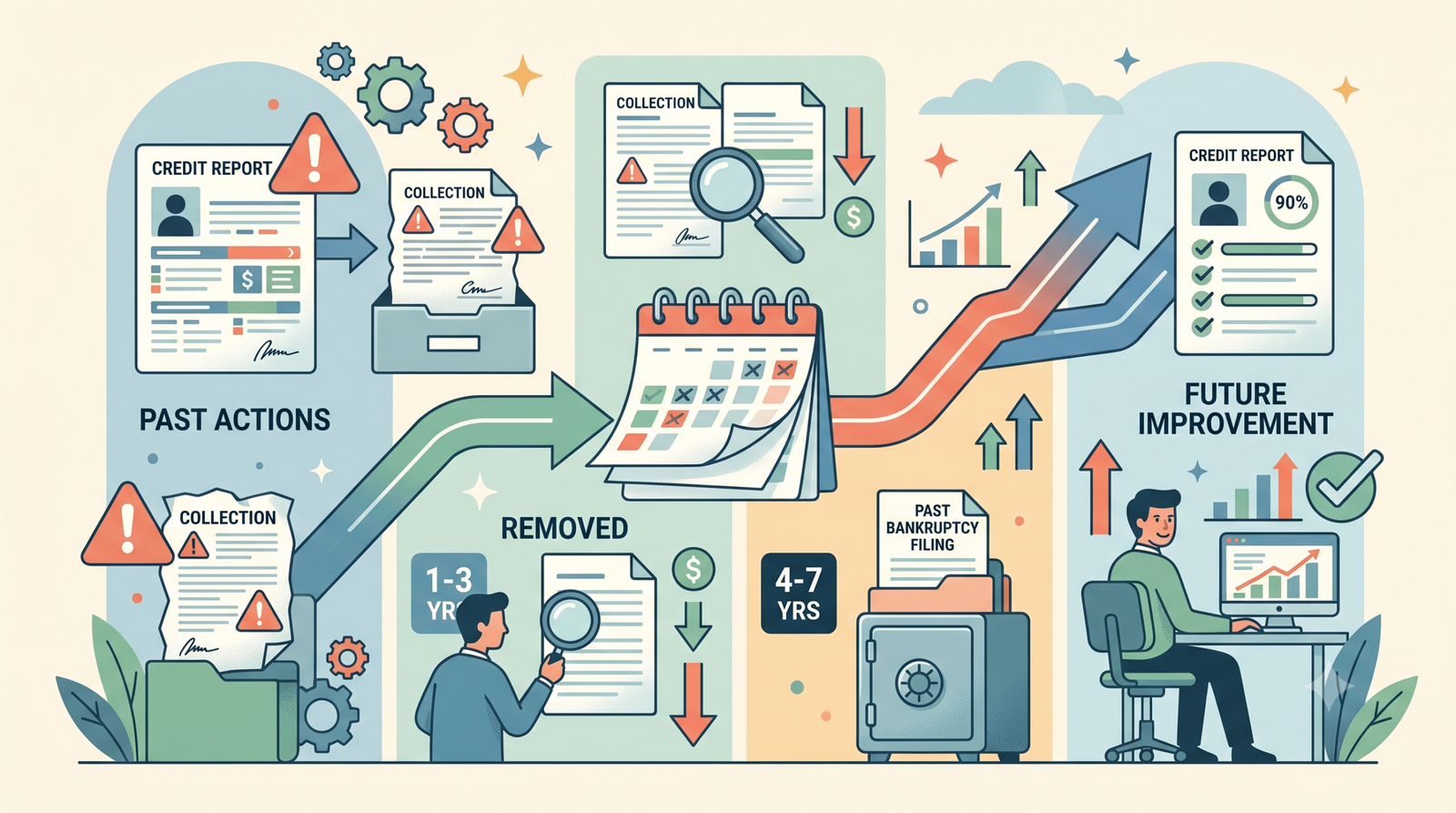
A negative item on your credit report can feel permanent, especially when you are trying to apply for housing, a loan, insurance, or another financial service.
You may wonder:
- When will this late payment disappear?
- How long will a collection account remain?
- Does paying the debt remove it?
- Can a credit repair company delete the information?
- Will your score improve before the item falls off?
- What happens if the information is incorrect?
The answer depends on the type of negative information, the reporting rules in your country, the date of the event, and whether the information is accurate.
In the United States, many accurate negative items can generally be reported for up to seven years, while some bankruptcy information can remain for longer. Other countries use different rules and time periods.
This guide explains how long negative items stay on a credit report, what common entries mean, how the reporting timeline is usually calculated, what payment does and does not change, and how to challenge information that is inaccurate.
This article is educational. Credit-reporting laws and limitation periods vary by location, so consult an appropriate local source for rules that apply to your situation.
What Is a Negative Credit Report Item?
A negative item is information that may suggest a borrower did not meet the terms of a credit agreement or financial obligation.
Examples include:
- Late payments
- Accounts in collections
- Defaults
- Charge-offs
- Repossessions
- Foreclosures
- Bankruptcy
- Some civil or public records, depending on local rules
- Accounts reported with incorrect payment status
Not every negative item has the same effect.
A recent missed payment may affect a credit profile differently from an older collection account. A paid collection may be treated differently from an unpaid one, depending on the scoring model and lender.
The item may remain visible even after its effect on your score becomes smaller.
This is important because two different timelines are involved:
- How long the item remains on the report
- How long the item affects decisions or scoring
An item may remain listed while becoming less influential as it gets older and newer positive information appears.
General Reporting Timelines
The following table describes common US reporting periods in general terms. Local rules and exceptions may differ.
| Negative Item | Common General Reporting Period |
|---|---|
| Late payments | Often up to 7 years |
| Collection accounts | Often up to 7 years |
| Charge-offs | Often up to 7 years |
| Repossessions | Often up to 7 years |
| Foreclosures | Often up to 7 years |
| Chapter 7 bankruptcy | May remain for up to 10 years |
| Chapter 13 bankruptcy | May remain for up to 7 years |
| Hard inquiries | Often up to 2 years, with a shorter scoring effect |
| Accurate negative information | Cannot usually be removed just because it is unfavorable |
These are general educational guidelines rather than a guarantee. The exact start date, account type, reporting agency, and applicable law matter.
A credit reporting agency should not continue reporting information beyond the permitted period, but errors can occur. That is why reviewing your reports is important.
Late Payments
A late payment may be reported when a payment is significantly past due, depending on the creditor’s reporting practices and applicable rules.
Some account statements may show stages such as:
- 30 days late
- 60 days late
- 90 days late
- 120 days late
- Default or charge-off
A payment that is only a few days late may result in a late fee without being reported to a credit bureau, but do not rely on a grace period unless the creditor confirms it.
A reported late payment can remain for a number of years. However, its effect may lessen as:
- The late payment becomes older
- You make later payments on time
- Your balances decline
- The rest of your credit profile improves
If a late payment is accurate, paying the account does not necessarily erase the original history. It may update the account to show that it was paid or brought current.
If the late payment is incorrect, dispute it with the reporting agency and the creditor that supplied the information.
Collection Accounts
A collection account may appear when an unpaid debt is transferred or assigned to a collection company.
Examples may include:
- Credit card debt
- Medical bills
- Utility bills
- Personal loans
- Service accounts
- Other unpaid obligations
Before paying a collection account, confirm:
- The collector is legitimate
- The amount is accurate
- The debt belongs to you
- The account is not duplicated
- The debt has not already been paid
- The proposed arrangement is clear
- You understand how payment will be recorded
Paying a collection account may update its status, but it does not always remove the entry immediately.
Some scoring models may treat paid collections differently from unpaid collections. The effect also depends on the type of debt and the model used by the lender.
Do not assume that payment automatically produces a specific score increase. Ask for written information about the arrangement and keep all records.
Charge-Offs and Defaults
A charge-off usually means a creditor has classified an account as seriously delinquent for accounting purposes. It does not necessarily mean the debt has disappeared.
The debt may still be:
- Collected by the original creditor
- Sold to another company
- Listed with a collection agency
- Subject to repayment efforts
- Reported according to applicable rules
A default is a serious failure to meet the terms of a credit agreement. The exact meaning varies by account type and country.
Paying a charged-off or defaulted account may change its status, but the original negative history may remain for the permitted reporting period.
Do not confuse the credit-reporting period with the legal time limit for collecting a debt. These can be separate issues. A debt may remain legally collectible under local law even after reporting rules change, or the reverse may apply.
Seek qualified local guidance if you are unsure about the legal status of an old debt.
Repossessions and Foreclosures
A repossession may occur when a lender takes back property after a borrower fails to meet the loan terms. A foreclosure is connected to the enforcement of a secured home loan.
These events can have a serious effect on a credit profile and may remain for several years under applicable reporting rules.
Paying any remaining balance does not necessarily remove the original event from the report.
If you are at risk of missing payments, contact the lender as early as possible. Possible options may include:
- Temporary hardship arrangements
- Modified payments
- Refinancing discussions
- Selling the asset
- Voluntary surrender
- Housing support or counseling
- Local legal or consumer assistance
Do not wait until the final stage if you already know that payments are becoming unmanageable.
Bankruptcy
Bankruptcy reporting periods vary by type and location.
In the United States, some bankruptcy information may remain on a credit report for up to ten years, while another type may generally remain for up to seven years.
Bankruptcy can affect more than a score. It may influence:
- Credit applications
- Housing applications
- Interest rates
- Insurance decisions in some regions
- Employment checks where permitted
- Future borrowing options
If you are considering bankruptcy, seek advice from a qualified professional who can explain the legal and financial consequences in your area. Do not rely on advertisements promising a simple or guaranteed outcome.
How Is the Reporting Date Calculated?
The date used for reporting can depend on the type of account and the original event.
This is why you should not assume the removal date based only on:
- The date a collection agency contacted you
- The date you started making payments
- The date the debt was sold
- The date a new company appeared
- The date you first noticed the item
Check the account history and reporting details carefully.
If an account appears to have been re-aged or given an incorrect date to extend the reporting period, document the issue and dispute inaccurate information.
Keep copies of:
- Original statements
- Collection letters
- Payment records
- Account agreements
- Credit reports
- Dispute correspondence
Good records make it easier to identify inconsistencies.
What Payment Changes and What It Does Not
Paying a negative account can be financially responsible, but payment does not automatically erase accurate history.
Payment may:
- Stop additional late charges
- Change an account status
- Reduce the balance
- Prevent further collection activity
- Improve your overall debt position
- Help future lenders see that the account is resolved
Payment may not:
- Remove an accurate late payment immediately
- Delete a legitimate collection instantly
- Guarantee a specific score increase
- Change the original date of the event
- Erase all other negative items
The decision to pay depends on the debt, interest, legal status, collection activity, and your wider financial situation.
Do not use essential emergency savings or miss current bills without considering the consequences.
How to Rebuild While Waiting
You do not have to wait for a negative item to disappear before improving your credit profile.
Focus on:
Paying Current Accounts on Time
Create reminders or automatic payments.
Reducing Revolving Balances
Lower balances gradually while keeping essential expenses covered.
Avoiding Unnecessary Applications
Apply selectively and understand whether the check is a hard inquiry. See hard inquiry vs soft inquiry.
Reviewing Reports Regularly
Look for new errors, duplicate entries, or unfamiliar activity.
Keeping New Accounts Manageable
Do not open accounts simply to create a score increase.
Building Emergency Savings
A small buffer can help prevent new late payments when an unexpected bill appears.
The goal is to create newer positive information that gradually becomes more important than older problems.
Can a Credit Repair Company Remove Negative Items?
Be cautious of companies that promise to:
- Remove all negative information
- Delete accurate late payments
- Guarantee a score increase
- Create a new credit identity
- Dispute every item on your report
- Fix credit within a few days
- Remove bankruptcy immediately
Accurate negative information generally cannot be legally erased simply because it is unfavorable. You can dispute inaccurate information yourself through the relevant reporting process.
A legitimate nonprofit counselor may help with budgeting or debt-management education, but investigate fees, services, and reputation carefully before signing anything.
A Realistic Credit Report Example
Suppose a person has:
- One late payment from four years ago
- A collection account from two years ago
- High credit card balances
- No missed payments during the last twelve months
The older late payment may still appear, but it may have less influence than when it was recent.
The person can improve the current profile by:
- Confirming the old information is accurate
- Disputing any errors
- Paying current accounts on time
- Reducing credit card balances
- Verifying the collection account
- Avoiding new unnecessary applications
The person may not see an instant transformation. However, the combination of accurate reporting and newer positive behavior can improve the overall profile over time.
Common Mistakes About Negative Credit Items
- Assuming payment instantly deletes the item: Payment may update the status without removing accurate history.
- Confusing credit reporting with debt collection laws: These are separate issues.
- Ignoring old accounts: Older information can still be incorrect or duplicated.
- Disputing everything: Dispute genuine errors, not accurate information.
- Paying a scam company: Be cautious of guarantees and upfront fees.
- Ignoring current bills: New late payments can create additional damage.
- Assuming every negative item lasts the same time: Reporting periods differ by item type.
- Waiting passively: Build positive payment history while older items age.
- Reapplying for credit repeatedly: Multiple applications can add new inquiries.
- Failing to keep records: Documentation helps when investigating errors.
Frequently Asked Questions
How long do late payments stay on a credit report?
In the United States, late payments are commonly reported for up to seven years. The exact rules vary by country, account, reporting agency, and circumstances.
Does paying a collection remove it from my report?
Not necessarily. Payment may update the account status, but an accurate collection may remain for the permitted reporting period. Treatment can vary by scoring model.
When does debt fall off a credit report?
The timing depends on the type of debt and applicable reporting rules. In many US cases, accurate negative information is reported for up to seven years, but bankruptcy and other items may follow different timelines.
Can I remove accurate negative information?
Usually not simply because it is negative. You may dispute information that is inaccurate, incomplete, duplicated, unauthorized, or reported beyond the permitted period.
Does old debt still affect my credit score?
It may. The influence often decreases as information becomes older, but the effect depends on the item, scoring model, and the rest of your credit profile.
Can a credit repair company remove old debt?
No company can legitimately guarantee the removal of accurate negative information. Be cautious of claims involving instant repair, new identities, or guaranteed score increases.
Should I pay an old collection account?
The answer depends on the debt’s accuracy, legal status, interest, collection activity, and your financial situation. Verify the account and consider qualified local guidance before agreeing to payment.
How can I improve credit while waiting for items to disappear?
Pay current accounts on time, reduce balances, avoid unnecessary applications, review reports, and prevent new negative information from being added.
Key Takeaways
- Negative credit items do not all remain for the same length of time.
- In the United States, many accurate negative items can generally be reported for up to seven years, while some bankruptcy information may remain longer.
- The reporting period and the scoring effect are different timelines.
- Paying a debt may update its status but does not always remove accurate history.
- Review your credit reports for errors, duplicate accounts, incorrect dates, and unfamiliar activity.
- Dispute inaccurate information with the reporting agency and the company that supplied it.
- Continue paying current accounts on time while older negative information ages.
- Be cautious of credit repair companies promising instant results or deletion of accurate information.
- Credit-reporting rules and debt-collection laws vary by location.
- Readers can continue with how credit scores work, how to repair bad credit, and debt payoff methods compared.
A negative item can affect your credit profile, but it does not define your financial future. Review the information carefully, correct genuine errors, prevent new problems, and give positive habits time to build.
There may be no instant way to erase accurate negative history, but there is a realistic path forward: understand what is being reported, manage current accounts carefully, and improve the information that lenders will see in the future.
This article is for informational purposes only and is not financial advice.
Leave a Reply
You must be logged in to post a comment.