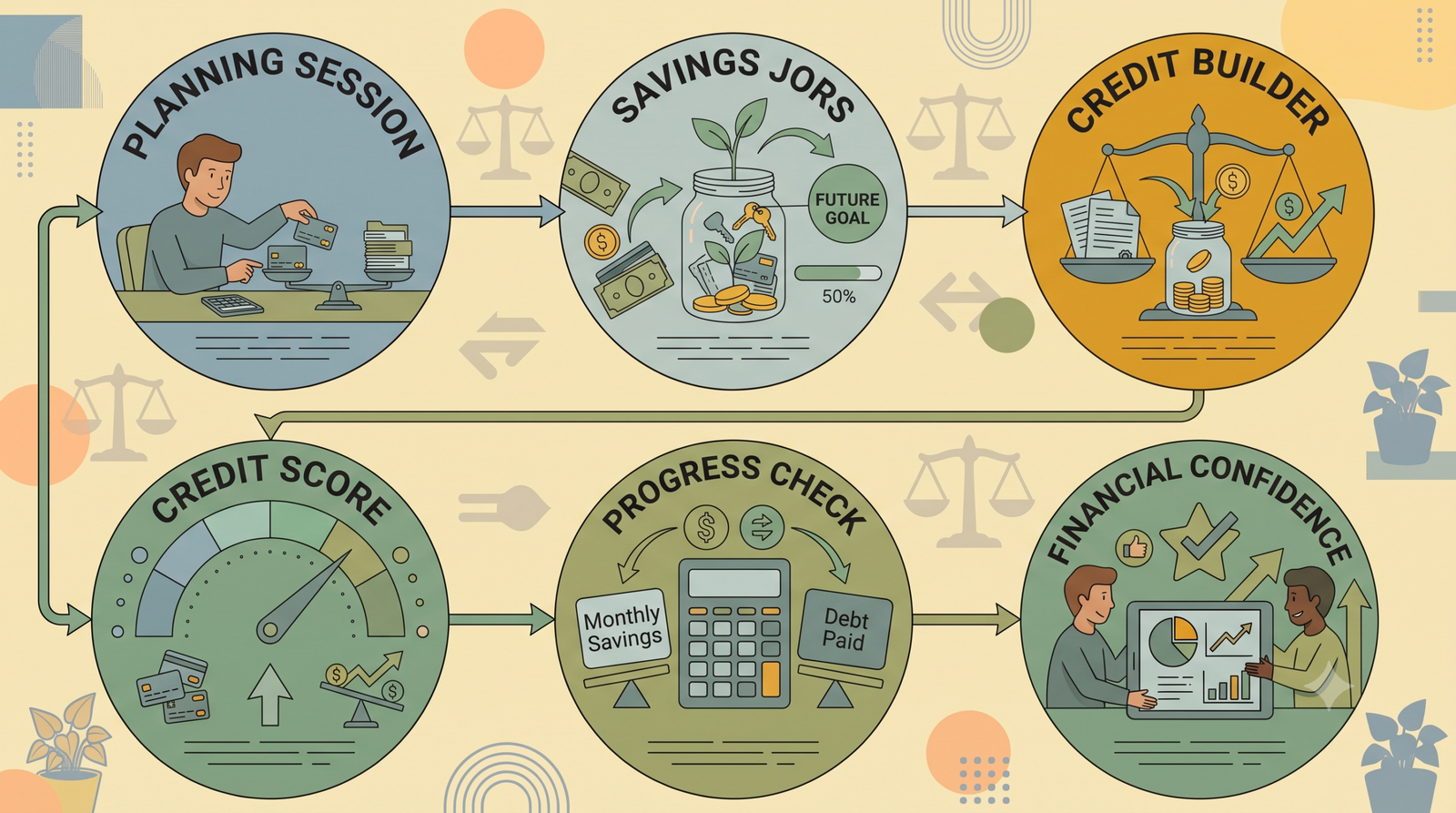
A credit score feels like a mysterious number handed down from somewhere unknowable — it moves without obvious explanation, and most people only think about it right before they need it, like when applying for a loan or an apartment. In reality, the formula behind it is well documented and far less mysterious than it seems once broken into its actual parts.
This guide breaks down exactly how credit scores work, which factors matter most, and how they’re weighted — so instead of guessing at what might help or hurt your score, you can see the actual mechanics behind the number.
What a Credit Score Actually Measures
A credit score is a three-digit number, typically ranging from 300 to 850, that summarizes how reliably you’ve historically managed borrowed money. Lenders use it as a shorthand for risk — a higher score generally signals a lower risk of missed payments, which is why it affects loan approval, interest rates, and sometimes even rental applications or insurance premiums.
It’s worth being clear about what a credit score is not: it’s not a measure of income, net worth, or overall financial health. Someone with a high income and healthy savings can still have a mediocre credit score if their credit history is short or inconsistent, and someone with a modest income can have an excellent score through consistent, reliable repayment habits.
This distinction trips people up more than almost anything else about credit scores. It’s tempting to assume the number reflects broader financial success, but it’s really a much narrower measurement — one built entirely from data about borrowing and repaying, not earning or saving. That narrowness is actually useful once understood, because it means the score responds to a specific, limited set of behaviors rather than to your entire financial life.
The Five Factors That Determine Your Score
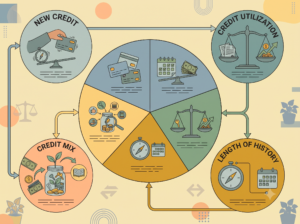
Credit scoring models weigh several factors differently, and understanding the weighting is what makes the number far less confusing.
Payment history (roughly 35% of the score). This is the single largest factor by a wide margin. It tracks whether payments on credit cards, loans, and other accounts were made on time. A single missed payment, especially one reported 30+ days late, can have a noticeably larger impact than almost anything else on this list. The effect also compounds — multiple missed payments across different accounts, or repeated late payments on the same account, tend to weigh more heavily than one isolated incident.
Credit utilization (roughly 30% of the score). This measures how much of your available credit you’re actually using, expressed as a percentage. Someone with a $10,000 credit limit and a $1,000 balance is using 10% of their available credit — generally considered healthy. The same $1,000 balance on a $2,000 limit is 50% utilization, which tends to weigh more heavily against the score even though the dollar amount owed is identical. This is calculated both per-card and across all accounts combined, so a single maxed-out card can drag down overall utilization even if other cards carry low balances.
Length of credit history (roughly 15% of the score). This considers how long accounts have been open, including the age of the oldest account and the average age of all accounts. This is part of why closing an old credit card, even one that’s rarely used, can sometimes lower a score — it shortens the average account age.
Credit mix (roughly 10% of the score). Having a mix of account types — credit cards, an auto loan, a mortgage — can contribute modestly to a stronger score, since it demonstrates the ability to manage different kinds of credit responsibly. This factor carries the least weight and generally isn’t worth opening a new account purely to diversify.
New credit inquiries (roughly 10% of the score). Applying for several new credit accounts in a short window can temporarily lower a score, partly because it can signal increased risk and partly due to the inquiries themselves. This factor is covered in more depth in our guide to hard inquiries vs soft inquiries.
How These Factors Interact in Practice

These five factors don’t operate in isolation — they interact, which is why two people with seemingly similar credit habits can have noticeably different scores.
Someone with a long credit history and low utilization can often absorb a single late payment better than someone with a short credit history and high utilization, simply because the other factors provide a stronger foundation. This is also why credit repair, covered in more detail in how to repair bad credit, tends to work best when it addresses multiple factors at once rather than fixating on just one.
It’s also worth understanding that different credit scoring models exist, and the exact weighting can vary slightly between them. The percentages above reflect commonly cited industry estimates rather than a single universal formula — but the relative importance (payment history and utilization mattering most, credit mix mattering least) holds true across most major scoring models.
What Doesn’t Affect Your Credit Score
A surprising amount of financial behavior has no direct effect on a credit score, despite common assumptions:
- Income — your salary isn’t factored into the score itself, though lenders may separately consider it during a loan application.
- Checking your own score — reviewing your own credit report or score is a soft inquiry and doesn’t lower it, a distinction covered fully in hard inquiry vs soft inquiry.
- Savings account balances — how much money you have saved has no bearing on the score, which measures borrowing behavior, not overall wealth.
- Rent and utility payments — in most standard scoring models, these aren’t automatically factored in unless specifically reported through a program designed to include them.
- Marital status — scores are calculated individually, not jointly, even for married couples with shared accounts.
Common Misunderstandings That Lead to Mistakes
- Believing a single factor controls the whole score. Payment history and utilization matter most, but a strong score comes from all five factors working together over time, not from optimizing one in isolation.
- Closing old credit cards to “clean up” credit. This often backfires by reducing average account age and total available credit, both of which can lower a score rather than improve it.
- Assuming a score updates instantly. Credit reports typically update on a monthly cycle as lenders report activity, so recent changes — a paid-down balance, a missed payment — may take a few weeks to reflect.
- Thinking a “good” score is the same for everyone. What counts as a strong score can vary slightly depending on the lender and the type of credit being applied for; a score sufficient for one type of loan may not be for another.
- Ignoring how long negative items linger. Missed payments and other negative marks don’t disappear immediately — see how long negative items stay on your credit report for the specific timelines.
- Applying for multiple new accounts right before a big purchase. Opening several new credit lines shortly before applying for a mortgage or auto loan can lower a score at exactly the moment it matters most, due to the combined effect of new inquiries and reduced average account age.
A Realistic Example
Consider two people, each with a $5,000 balance spread across their credit cards. The first has $6,000 in total available credit, putting utilization at roughly 83% — very high. The second has $25,000 in total available credit, putting the same $5,000 balance at 20% utilization — a meaningfully healthier position, despite owing the exact same dollar amount.
If both have otherwise similar payment histories and account ages, the second person is likely to have a noticeably higher score, purely because of how the same debt is proportioned against available credit. This is exactly why utilization is weighted so heavily — it reflects not just how much someone owes, but how close they are to their borrowing limits, which correlates with future repayment risk.
If the first person pays that balance down to $1,200 — bringing utilization to 20% — without any other changes, their score would typically show meaningful improvement within one to two reporting cycles, illustrating how directly and relatively quickly this particular factor can move the number.
Frequently Asked Questions
How often does a credit score update?
Most scores update monthly, as lenders report account activity to credit bureaus. The exact timing can vary slightly depending on when each individual lender reports.
Can I have different credit scores from different sources?
Yes. Different credit bureaus and different scoring models can produce slightly different numbers based on the data each has on file and the specific formula used. This is normal and doesn’t indicate an error.
Does checking my credit score lower it?
No. Checking your own score is considered a soft inquiry and has no effect on the score itself — only certain types of inquiries made by lenders during a credit application count as hard inquiries.
What’s considered a “good” credit score?
Ranges vary by scoring model, but generally scores in the upper-600s to 700s are considered good, and scores above that are considered very good to excellent. What’s required for approval varies by lender and loan type.
Can paying off debt actually lower my score temporarily?
In some cases, yes, though usually only slightly and temporarily. Closing an account after paying it off can reduce total available credit and average account age, both of which can cause a small, short-term dip even though the underlying financial position has improved.
Key Takeaways
- Payment history and credit utilization together account for roughly two-thirds of a typical credit score — they matter far more than any other single factor.
- Length of credit history, credit mix, and new credit inquiries round out the remaining weight, in that order of importance.
- Some common financial behaviors — income, savings, checking your own score — have no direct effect on the number at all.
- Understanding the mechanics behind the score makes it possible to make deliberate improvements rather than guessing, whether that means tackling credit repair or simply understanding why a score dropped unexpectedly.
- Credit habits also connect directly to debt payoff strategy — the two are closely linked in practice, even though they’re often treated as separate topics.
A credit score isn’t a judgment of character or overall financial success — it’s a narrow, mechanical measurement of borrowing and repayment behavior over time. Once the five factors and their relative weight are visible, the number stops being mysterious and starts being something that responds predictably to specific, understandable actions.
This article is for informational purposes only and is not financial advice.
Leave a Reply
You must be logged in to post a comment.