Paying off debt can feel overwhelming when several balances compete for your attention.
You may have:
- Credit card balances
- Personal loans
- Medical bills
- Student loans
- Auto loans
- Buy-now-pay-later accounts
- Family loans
- Overdue bills
- Collection accounts
Each debt may have a different balance, interest rate, minimum payment, and due date. Looking at the total amount can create so much stress that you do not know where to begin.
A debt payoff strategy gives your extra money a direction. It helps you decide which balance to prioritize while keeping required payments current on the others.
There is no single method that works perfectly for everyone. The best strategy is one you can follow consistently without creating new debt for everyday expenses.
This guide explains debt payoff strategies, how to compare the debt snowball and avalanche methods, how to choose a realistic extra payment, and when consolidation or negotiation may be worth considering.
Debt rules and available options vary by country and lender. This article is general education, not personalized debt advice.
Start With a Complete Debt List
Before choosing a strategy, write down every debt.
Include:
- Creditor
- Balance
- Interest rate
- Minimum payment
- Due date
- Loan term
- Fees
- Secured or unsecured status
- Fixed or variable rate
- Current or overdue status
A simple table may look like this:
| Debt | Balance | Interest Rate | Minimum Payment | Due Date |
|---|---|---|---|---|
| Credit card A | $2,400 | 24% | $75 | 10th |
| Personal loan | $5,000 | 11% | $160 | 15th |
| Auto loan | $8,500 | 7% | $240 | 22nd |
| Medical bill | $900 | 0% | $75 | 28th |
The total balance matters, but it should not be the only number you consider.
A high-interest balance may grow quickly. A small balance may be easier to eliminate and provide motivation. A secured loan may have consequences if payments are missed.
The list turns an unclear problem into specific information.
Protect Essential Payments First
Before sending extra money toward one balance, keep required payments current on every account.
Prioritize:
- Housing
- Utilities
- Food
- Medication
- Transportation needed for work
- Insurance
- Minimum debt payments
- Required family or legal obligations
Missing a payment while focusing on another debt can create fees, collection activity, or additional credit damage.
A debt payoff strategy should be built on top of a stable basic budget. If essential expenses are not covered, reducing debt may require additional income, assistance, lower costs, or professional guidance.
Choose a Starter Emergency Buffer
Using every dollar to pay debt can leave you vulnerable to the next unexpected expense.
A small emergency buffer may help with:
- Vehicle repairs
- Medical costs
- Delayed income
- Essential replacement items
- Urgent travel
- Household repairs
The appropriate amount depends on your household. Some people begin with $100, $250, or $500 before directing all extra money toward debt.
The purpose is not to avoid debt repayment. It is to reduce the chance that one surprise immediately creates a new balance.
Debt Snowball Method
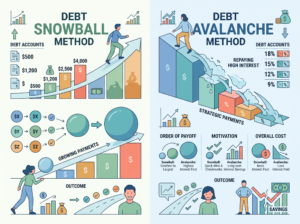
The debt snowball method prioritizes debts from smallest balance to largest, regardless of interest rate.
The process is:
- Pay the minimum on every debt.
- Direct extra money toward the smallest balance.
- Eliminate that balance.
- Add its former payment to the next debt.
- Continue until all debts are paid.
Example
- Medical bill: $400
- Credit card: $2,000
- Personal loan: $5,000
The medical bill is paid first, even if the credit card has a higher interest rate.
Advantages
- Creates an early win
- Reduces the number of accounts
- Simplifies monthly payments
- Builds motivation
- May feel emotionally manageable
Disadvantages
- May cost more interest
- A high-interest debt may remain for longer
- The mathematically cheapest option may not be the fastest
The snowball method can work well for people who need visible progress to stay committed.
Debt Avalanche Method
The debt avalanche method prioritizes the highest interest rate first, regardless of balance.
The process is:
- Pay the minimum on every debt.
- Direct extra money toward the highest-interest balance.
- Pay it off.
- Move to the next-highest rate.
- Continue until the debts are cleared.
Example
- Credit card: $2,000 at 24%
- Personal loan: $5,000 at 11%
- Auto loan: $8,500 at 7%
The credit card receives extra payments first.
Advantages
- May reduce total interest
- Targets the most expensive debt
- Can be mathematically efficient
- May shorten the cost of borrowing
Disadvantages
- The first debt may take a long time to eliminate
- Progress may feel slower
- It can be harder to stay motivated
- Small balances with lower rates remain open
The avalanche method may suit someone who is comfortable waiting for the financial benefit of reducing high-interest debt.
Compare Snowball and Avalanche
| Feature | Debt Snowball | Debt Avalanche |
|---|---|---|
| Priority | Smallest balance | Highest interest rate |
| Main benefit | Motivation and quick wins | Interest savings |
| Emotional experience | Visible progress | Slower early results |
| Mathematical cost | May be higher | Often lower |
| Best for | People who need momentum | People focused on minimizing interest |
| Required payments | Minimum on all debts | Minimum on all debts |
Neither method works if you stop paying required amounts or continue adding new high-cost debt.
The best method is the one you can continue using.
Consider a Hybrid Strategy
You do not have to follow one method perfectly.
A hybrid strategy may involve:
- Paying off one very small balance
- Then targeting the highest-interest debt
- Prioritizing overdue or urgent accounts
- Handling a debt with legal or collateral consequences
- Using a bonus to eliminate a specific balance
- Negotiating a lower rate before choosing the order
For example, you might pay off a $200 balance to simplify your budget, then direct future extra money toward a credit card with a high interest rate.
The strategy should reflect both mathematics and behavior.
Increase the Amount You Pay
The payoff method matters, but the extra amount often matters more.
Possible sources include:
- Reducing subscriptions
- Lowering monthly bills
- Cooking more meals at home
- Selling unused items
- Working additional hours
- Freelance income
- Seasonal work
- Applying bonuses
- Directing part of a raise
- Reducing optional spending temporarily
Do not make the extra payment so large that you cannot cover basic needs or predictable expenses.
A consistent additional payment is generally more useful than an ambitious payment that lasts only one month.
Reduce the Interest Cost
Interest can slow progress, especially on revolving balances.
Potential options may include:
- Asking the lender for a lower rate
- Comparing a balance transfer
- Reviewing refinancing
- Consolidating debts
- Improving payment history
- Using an appropriate nonprofit counseling service
- Negotiating a payment arrangement
Read how to negotiate a lower interest rate for a more detailed discussion.
A lower monthly payment is not always a lower total cost. Compare:
- Interest rate
- Fees
- Repayment term
- Total amount paid
- Variable or fixed rate
- Consequences of missed payments
Do not accept a new loan simply because the payment looks smaller.
Debt Consolidation
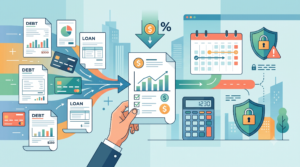
Debt consolidation combines multiple debts into one account or payment.
Possible benefits include:
- Fewer payments
- Simplified tracking
- A potentially lower interest rate
- A clear repayment date
- Reduced administrative stress
Possible risks include:
- Origination fees
- Longer repayment
- Higher total interest
- Variable rates
- New borrowing after consolidation
- Loss of protections
- Secured debt consequences
Consolidation only helps if it improves the overall situation and does not encourage new spending.
Read debt consolidation pros and cons before accepting an offer.
Track Progress Without Becoming Obsessed
Review your debt plan monthly.
Track:
- Balance changes
- Interest charged
- Extra payments
- Remaining accounts
- Progress toward the next milestone
- Changes in income
- New expenses
- Emergency savings
Celebrate milestones without spending money that belongs to the payoff plan.
For example:
- First $500 paid
- One account eliminated
- Credit card balance below a target
- Total debt reduced by 10%
- A full month without new debt
Progress may feel slow, but a balance declining consistently is evidence that the plan is working.
A Realistic Debt Payoff Example
Suppose someone has:
- Credit card: $3,000 at 24%
- Personal loan: $4,000 at 12%
- Medical bill: $600 at 0%
They can pay all minimums and have an additional $250 per month.
Using the avalanche method, they prioritize the credit card because it has the highest interest rate.
Using the snowball method, they prioritize the medical bill because it has the smallest balance.
The snowball may eliminate one account quickly, while the avalanche may reduce interest costs more efficiently.
The person chooses the snowball because previous plans failed when progress felt invisible. After clearing the medical bill, they add its payment to the credit card and continue.
The best strategy is not only the one with the lowest theoretical cost. It is the one that the person can maintain without creating new debt.
Common Debt Payoff Mistakes
- Paying only the minimum: Minimum payments can keep debt active for a long time.
- Ignoring interest rates: High-cost debt can grow quickly.
- Using all savings to pay debt: A lack of emergency cash may create new borrowing.
- Choosing a method you cannot follow: A mathematically efficient plan may fail behaviorally.
- Continuing new credit card spending: Debt cannot decline if new balances replace payments.
- Focusing only on one account: Keep all required payments current.
- Ignoring fees: New repayment products may cost more than expected.
- Extending the repayment term without calculating total cost: Lower payments may mean higher overall cost.
- Believing debt settlement promises: Some companies charge fees and cannot guarantee results.
- Feeling ashamed and avoiding statements: Accurate information is necessary for a solution.
Frequently Asked Questions
What is the best debt payoff strategy?
The best strategy is one you can follow consistently. The snowball prioritizes small balances for motivation, while the avalanche prioritizes high interest rates to reduce borrowing costs.
How can I pay off debt faster?
Pay required amounts on time, direct extra money toward one priority balance, reduce new borrowing, lower interest where possible, and apply extra income carefully.
Should I use the snowball or avalanche method?
Choose the snowball if quick wins help you stay motivated. Choose the avalanche if reducing interest is your main priority and you can stay committed to slower early progress.
Should I save money while paying off debt?
A small emergency buffer can help prevent new debt. The right balance depends on interest rates, income stability, required payments, and household circumstances.
Is debt consolidation a good idea?
It may help if it reduces complexity or cost, but compare fees, terms, interest, repayment length, and total cost. Consolidation does not solve the problem if new debt continues.
Can I negotiate a lower interest rate?
You may ask a lender or provider whether a lower rate or alternative arrangement is available. Results vary, and any new agreement should be reviewed carefully.
How do I stay motivated while paying off debt?
Track milestones, use a written plan, choose realistic payments, celebrate progress without overspending, and focus on reducing balances rather than comparing yourself with others.
What if my income is not enough to cover minimum payments?
Contact creditors early, review essential expenses, seek reputable nonprofit or community support, and consider qualified local debt guidance. Do not ignore the accounts.
Key Takeaways
- Begin by listing every debt, balance, interest rate, minimum payment, and due date.
- Keep required payments current before directing extra money to one account.
- Build a small emergency buffer if possible.
- The debt snowball prioritizes the smallest balance for motivation.
- The debt avalanche prioritizes the highest interest rate for potential interest savings.
- A hybrid approach can combine financial efficiency with psychological momentum.
- Increase extra payments only when the amount is realistic and sustainable.
- Compare interest rates, fees, terms, and total costs before consolidating.
- Track progress monthly and adjust when income or responsibilities change.
- Readers can continue with debt snowball vs debt avalanche, why paying off debt feels hard, and how to negotiate a lower interest rate.
- Learn more about debt consolidation pros and cons before accepting a new repayment product.
Debt payoff is rarely solved by one dramatic action. It usually improves through a clear list, current payments, a realistic strategy, and repeated extra contributions.
Choose a method that fits both your numbers and your behavior. The most efficient plan on paper is not useful if it causes you to give up, miss essential payments, or take on new debt.
This article is for informational purposes only and is not financial advice.
Leave a Reply
You must be logged in to post a comment.