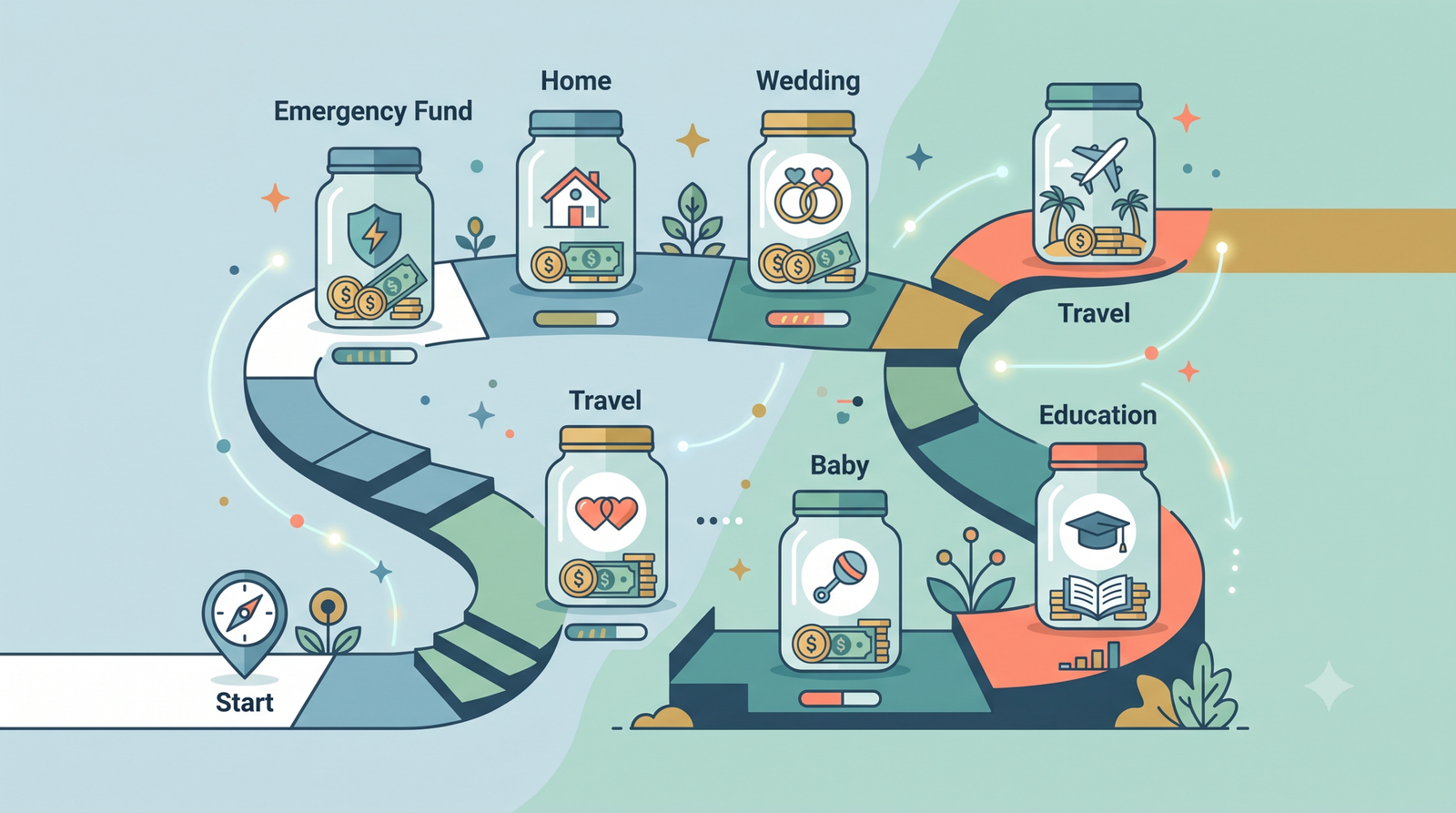
Saving money is easier when you have one clear goal. But real life rarely gives you only one financial priority.
You may want to build an emergency fund while saving for a wedding, a home, education, a vehicle, a baby, or a family trip. At the same time, you may have debt payments, annual bills, and everyday expenses that also require money.
When several goals compete, it can feel as though you are making progress toward none of them.
The solution is not always to choose one goal and ignore everything else. A goal-based saving system helps you organize several priorities, decide what comes first, and give each goal a realistic amount.
This guide explains goal-based saving, how to prioritize multiple goals, calculate monthly contributions, create separate savings categories, manage competing deadlines, and adjust your plan when income changes.
It also connects with how much insurance you need, because financial goals and protection planning often work together.
What Is Goal-Based Saving?
Goal-based saving means assigning money to specific purposes instead of placing all savings into one general account without a plan.
Common goals include:
- Emergency savings
- Wedding expenses
- A home down payment
- A baby fund
- Education
- A vehicle
- Travel
- Home repairs
- Business startup costs
- Retirement
- Annual bills
Each goal has its own:
- Purpose
- Target amount
- Deadline
- Monthly contribution
- Priority level
- Suitable savings location
This approach makes progress easier to see.
Instead of saying:
I need to save more.
you can say:
I am saving $150 per month for an emergency fund and $100 per month for a home deposit.
The goal is not to create dozens of complicated accounts. It is to make your priorities visible and prevent money intended for one purpose from being spent on another.
Why Saving for Multiple Goals Feels Difficult
Multiple goals compete for the same income.
You may have:
- Limited monthly savings
- Different deadlines
- Goals with different importance
- Unexpected expenses
- Variable income
- Debt payments
- Family responsibilities
- Rising prices
A goal with a distant deadline can feel less urgent than one due soon. However, ignoring long-term goals for too long may make them more expensive or difficult later.
You may also experience emotional pressure. A wedding, baby, home, or education goal may feel too important to delay, while an emergency fund may feel less exciting even though it provides financial protection.
A written priority system helps separate emotion from the order of action.
Choose Your Financial Priorities
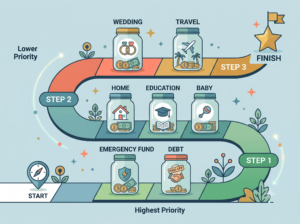
Start by listing every goal and answering four questions:
1. Is the Goal Necessary or Optional?
Emergency savings, essential repairs, and required education costs may deserve priority over optional travel or lifestyle upgrades.
2. Does the Goal Have a Deadline?
A goal due in six months may require more attention than one planned for ten years from now.
3. What Happens If I Delay It?
Consider:
- Additional costs
- Lost opportunities
- Penalties
- Borrowing
- Stress
- Safety
- Family impact
4. How Flexible Is the Target?
Some goals have a fixed amount, while others can be adjusted.
For example:
- A required tuition bill may be fixed
- A wedding budget may be flexible
- A home deposit may change with the property price
- A vacation may be shortened
- A vehicle may be replaced with a lower-cost option
Use these questions to rank goals as:
- Immediate
- Important
- Long term
- Optional
- Flexible
Build a Goal-Saving Table
Create a table with the information for each goal.
| Goal | Target | Current Amount | Deadline | Remaining | Monthly Contribution |
|---|---|---|---|---|---|
| Emergency fund | $2,000 | $500 | 10 months | $1,500 | $150 |
| Wedding | $6,000 | $1,200 | 20 months | $4,800 | $240 |
| Home deposit | $20,000 | $4,000 | 5 years | $16,000 | $267 |
| Vacation | $1,200 | $200 | 12 months | $1,000 | $84 |
The total monthly contribution would be approximately $741.
If that amount is not realistic, adjust:
- Deadlines
- Target amounts
- Goal priorities
- Income
- Flexible spending
- Contribution percentages
The table reveals whether the goals are compatible with your income. Without it, you may commit to several targets that require more money than you can save.
Use a Basic Contribution Formula
The basic calculation is:
Amount remaining ÷ Months available = Monthly contribution
For example:
- Goal: $5,000
- Current savings: $1,000
- Remaining amount: $4,000
- Time available: 20 months
$4,000 ÷ 20 = $200 per month
This calculation assumes no interest, fees, or investment growth. It is a simple planning estimate.
If your income varies, use a conservative monthly amount and assign extra income separately.
You may also use a percentage system. For example:
- 50% of savings toward the most urgent goal
- 30% toward an important medium-term goal
- 20% toward a long-term goal
The specific percentages are less important than having a clear method.
Give Every Goal a Separate Category
You can organize goals using:
- Separate savings accounts
- Bank sub-accounts
- Spreadsheet categories
- Digital envelopes
- Physical envelopes
- A savings app
- A combination of methods
Separate categories help answer:
- How much is available?
- Am I using the right money?
- Which goal is behind?
- What progress have I made?
You do not necessarily need a separate bank account for every goal. A spreadsheet can track several goals within one account if the money remains organized.
However, emergency savings should generally be easy to access and not mixed with money intended for optional spending.
Build an Emergency Fund Alongside Other Goals
An emergency fund may not feel as exciting as a wedding, vacation, or home deposit, but it protects other goals.
Without emergency savings, an unexpected expense may force you to:
- Use a credit card
- Borrow from family
- Delay another goal
- Sell investments
- Take out a high-cost loan
- Cancel a planned event
Start with a modest target if necessary:
- $100
- $250
- $500
- One week of essential expenses
Once the first level is reached, continue building according to your income stability and household responsibilities.
An emergency fund does not need to be complete before you work on any other goal. The appropriate balance depends on your circumstances.
Handle Debt While Saving
Debt and saving goals can compete.
Consider:
- Minimum payments
- Interest rates
- Required deadlines
- Emergency savings
- The risk of taking on new debt
- The emotional benefit of reducing a balance
Always keep required payments current.
You may decide to:
- Build a starter emergency fund
- Direct extra money toward high-cost debt
- Continue a small contribution toward another important goal
- Increase savings after the debt is reduced
There is no single method that fits everyone. The key is to avoid saving for a goal while repeatedly adding expensive new debt for everyday expenses.
Match the Saving Method to the Timeline
Money needed soon generally needs to remain accessible and relatively stable.
Short-term goals may include:
- Emergency expenses
- Tuition
- A wedding within a year
- A vehicle purchase
- A move
- A planned medical expense
Long-term goals may have a longer time horizon, but the suitable approach depends on your financial circumstances, risk tolerance, local rules, and access to appropriate products.
Do not put money needed soon into an option that could fall sharply when you need it.
Before choosing a savings or investment product, understand:
- Access rules
- Fees
- Interest
- Tax treatment where applicable
- Penalties
- Minimum balances
- Risk
- Timing
A higher possible return is not automatically suitable for every goal.
Use Sinking Funds for Predictable Costs
A sinking fund is money set aside gradually for a known future expense.
Examples include:
- Holiday gifts
- Car repairs
- Insurance premiums
- School supplies
- Annual subscriptions
- Home maintenance
- Medical expenses
- Birthdays
- Travel
For example, if you expect $600 in annual vehicle maintenance, saving $50 per month creates a fund before the expense arrives.
Sinking funds are different from emergency funds:
- An emergency fund covers unexpected events
- A sinking fund covers expected future costs
Separating them helps prevent planned costs from consuming emergency savings.
Read what is a sinking fund for a detailed explanation.
Review Progress Monthly
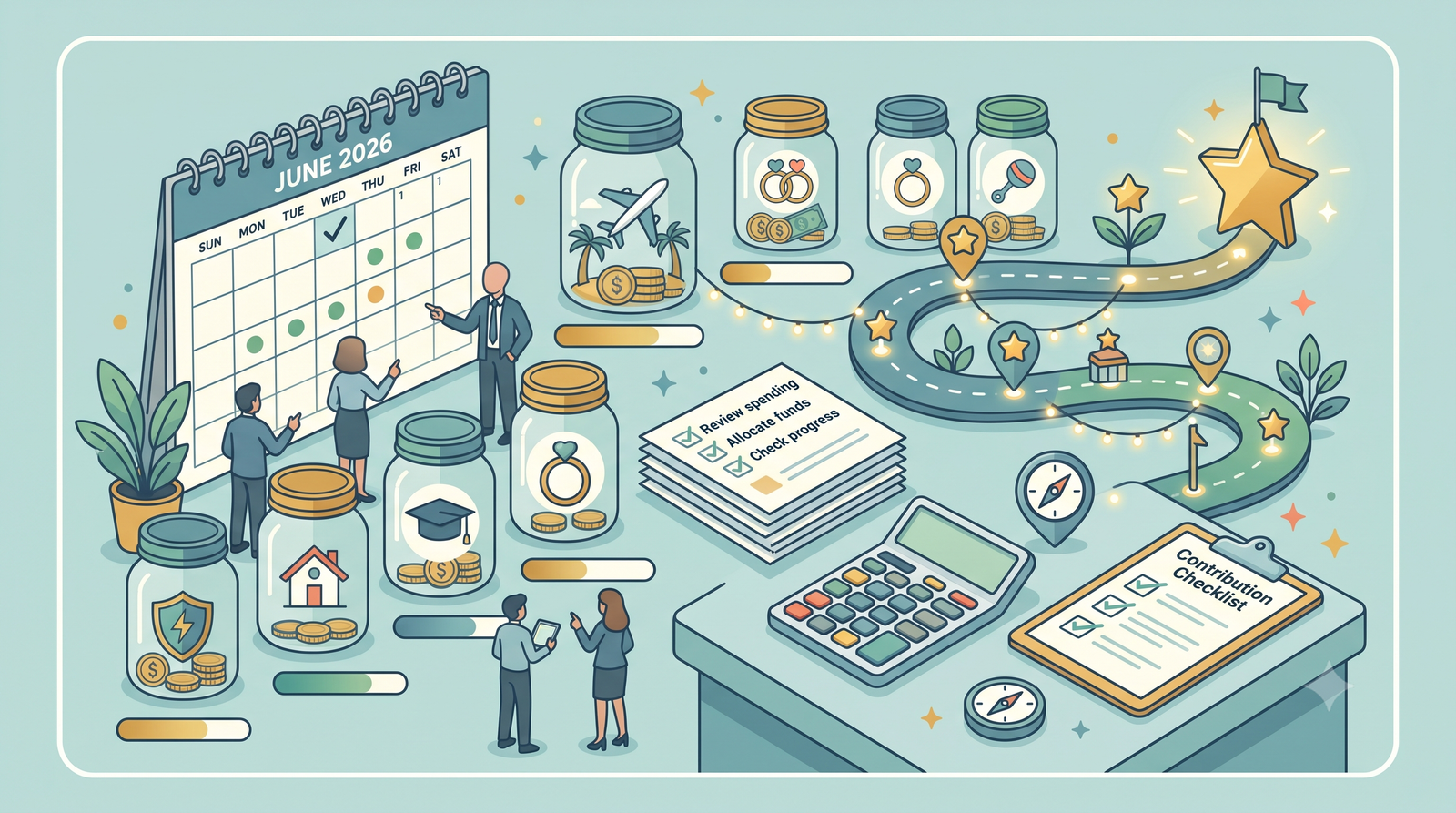

At the end of each month, review:
- How much did you save?
- Which goals received contributions?
- Did any goal fall behind?
- Did an unexpected expense change priorities?
- Is the deadline still realistic?
- Should the target amount change?
- Are you saving too little or too much for one goal?
- Can extra income be assigned?
A monthly review should help you adjust rather than create guilt.
If a goal is no longer relevant, redirect the money to another priority. If a goal becomes more expensive, revise the target and deadline.
Use Extra Income Intentionally
Extra income may include:
- Bonuses
- Overtime
- Freelance payments
- Gifts
- Tax refunds
- Seasonal work
- Selling unused belongings
- A raise
Decide in advance how extra money will be divided.
For example:
- 40% emergency savings
- 30% debt repayment
- 20% wedding or home goal
- 10% personal spending
The amounts are examples only. The benefit comes from making the decision before the money disappears into unplanned spending.
A larger one-time contribution can also help a goal that has a close deadline.
A Realistic Multiple-Goal Example
Suppose a household can save $600 per month.
Its priorities are:
- Emergency fund
- Wedding
- Home deposit
- Annual car expenses
The household decides:
| Goal | Monthly Amount |
|---|---|
| Emergency fund | $200 |
| Wedding | $150 |
| Home deposit | $150 |
| Car sinking fund | $100 |
| Total | $600 |
After six months:
- Emergency fund increases by $1,200
- Wedding fund increases by $900
- Home fund increases by $900
- Car fund increases by $600
If a vehicle repair uses $400 from the car fund, the household does not need to treat it as a financial failure. That money was saved for exactly this purpose.
Later, when the emergency fund reaches its first target, the household may redirect part of its $200 contribution toward the wedding or home deposit.
The system changes as goals are completed.
Common Goal-Based Saving Mistakes
- Setting too many goals: Too many categories can make progress invisible.
- Ignoring emergency savings: A surprise expense may force you to abandon other goals.
- Using one account without tracking: Money can be spent for the wrong purpose.
- Choosing unrealistic deadlines: A target that requires impossible contributions will fail.
- Forgetting annual expenses: Predictable costs still need planning.
- Saving while creating new expensive debt: New borrowing can cancel out progress.
- Not adjusting for price changes: Some goals become more expensive over time.
- Using risky investments for short-term goals: A decline may occur when you need the money.
- Spending extra income automatically: One-time money can support important priorities.
- Treating setbacks as failure: Adjust the plan and continue.
Frequently Asked Questions
What is goal-based saving?
Goal-based saving means assigning money to specific financial purposes, such as emergencies, a home, education, a wedding, or travel, instead of saving without a defined plan.
How can I save for multiple goals at once?
List every goal, rank priorities, calculate the amount needed, divide contributions among categories, and review the plan monthly. Use separate accounts or clear tracking categories.
Should I save for an emergency fund or another goal first?
Many people begin with a small emergency buffer while also contributing modestly to an important goal. The right balance depends on income stability, debt, responsibilities, and deadlines.
How many savings goals should I have?
There is no universal limit, but too many active goals may divide your money and attention. Start with one main goal, one protection goal, and only a few additional priorities.
What if I cannot save enough for every goal?
Extend deadlines, reduce target amounts, prioritize urgent goals, increase income, or pause optional goals. A realistic plan is better than an impossible one.
Should short-term savings be invested?
Money needed soon generally requires accessibility and stability. Understand risk, fees, and timing before choosing where to keep funds.
What is the difference between a sinking fund and an emergency fund?
A sinking fund is for a known future expense, such as annual insurance or car maintenance. An emergency fund is for unexpected financial problems.
How often should I review my savings plan?
A monthly review is useful for checking contributions, deadlines, and changes in priorities. Review sooner after an income change, major expense, or family event.
Key Takeaways
- Goal-based saving assigns money to specific purposes.
- List every goal, then rank each by urgency, importance, deadline, and flexibility.
- Use a target amount, current balance, deadline, and monthly contribution.
- Separate savings categories so you know what each dollar is for.
- Build an emergency fund alongside other goals when possible.
- Use sinking funds for predictable expenses.
- Match the savings method to the time horizon and risk of the goal.
- Assign extra income intentionally instead of spending it automatically.
- Review your plan monthly and adjust deadlines or contributions when life changes.
- Readers can continue with saving for a wedding, saving money for a baby, and saving for a down payment.
- The guide on sinking funds provides a more detailed method for planned expenses.
Saving for multiple goals is not about giving every goal the same amount of money. It is about deciding what matters most, protecting your financial stability, and creating a system that moves each priority forward at a realistic pace.
Some goals will be completed and removed. Others will change as your income, family, and plans change. A flexible goal-based system allows your savings plan to change without losing direction.
This article is for informational purposes only and is not financial advice.
Leave a Reply
You must be logged in to post a comment.