
A wedding can be one of the most meaningful events in a couple’s life, but it can also create serious financial pressure.
Costs may include:
- Venue
- Food
- Clothing
- Photography
- Decorations
- Invitations
- Transportation
- Music
- Flowers
- Accommodation
- Gifts
- Family events
- Legal or administrative fees
The difficulty is that wedding spending often grows through small additions. A larger guest list leads to more food, invitations, chairs, favors, and transport. A few upgrades can turn an affordable plan into a budget that requires credit cards or loans.
Saving for a wedding does not mean removing all enjoyment from the celebration. It means deciding what matters most, setting a realistic target, and making choices that do not create unnecessary debt before married life begins.
This guide explains how to save for a wedding, create a realistic wedding budget, reduce unnecessary costs, discuss financial expectations with family, and handle changes when the available money is limited.
It also connects to goal-based saving, because a wedding is one financial goal that may compete with emergency savings, debt repayment, housing, and other priorities.
Start With the Total Wedding Budget
Before choosing colors, venues, or decorations, decide what the wedding can realistically cost.
The budget may come from:
- Your own savings
- Monthly contributions
- Family support
- Gifts
- A partner’s savings
- Income from additional work
- A combination of sources
Do not count money that has not been promised or received. If family members offer support, discuss whether the amount is fixed, when it will be available, and whether it comes with expectations.
A wedding budget should not depend on borrowing that you cannot comfortably repay.
Write down:
- Total amount available
- Current wedding savings
- Monthly amount you can save
- Number of months remaining
- Expected contributions from others
- Essential household costs
- Existing debt
- Emergency savings needs
This gives you a realistic starting point.
Set a Wedding Date That Fits the Goal
The wedding date affects how much you need to save each month.
Use this formula:
Total wedding cost still needed ÷ Months remaining = Monthly contribution
For example:
- Estimated wedding cost: $12,000
- Current wedding savings: $3,000
- Remaining amount: $9,000
- Time available: 18 months
$9,000 ÷ 18 = $500 per month
If $500 per month is not realistic, you have several choices:
- Extend the timeline
- Reduce the guest list
- Lower the target amount
- Increase income
- Ask for confirmed family support
- Choose a less expensive venue
- Reduce optional upgrades
The date should support the budget, not force you into unaffordable borrowing.
Separate Wedding Needs From Wedding Wants
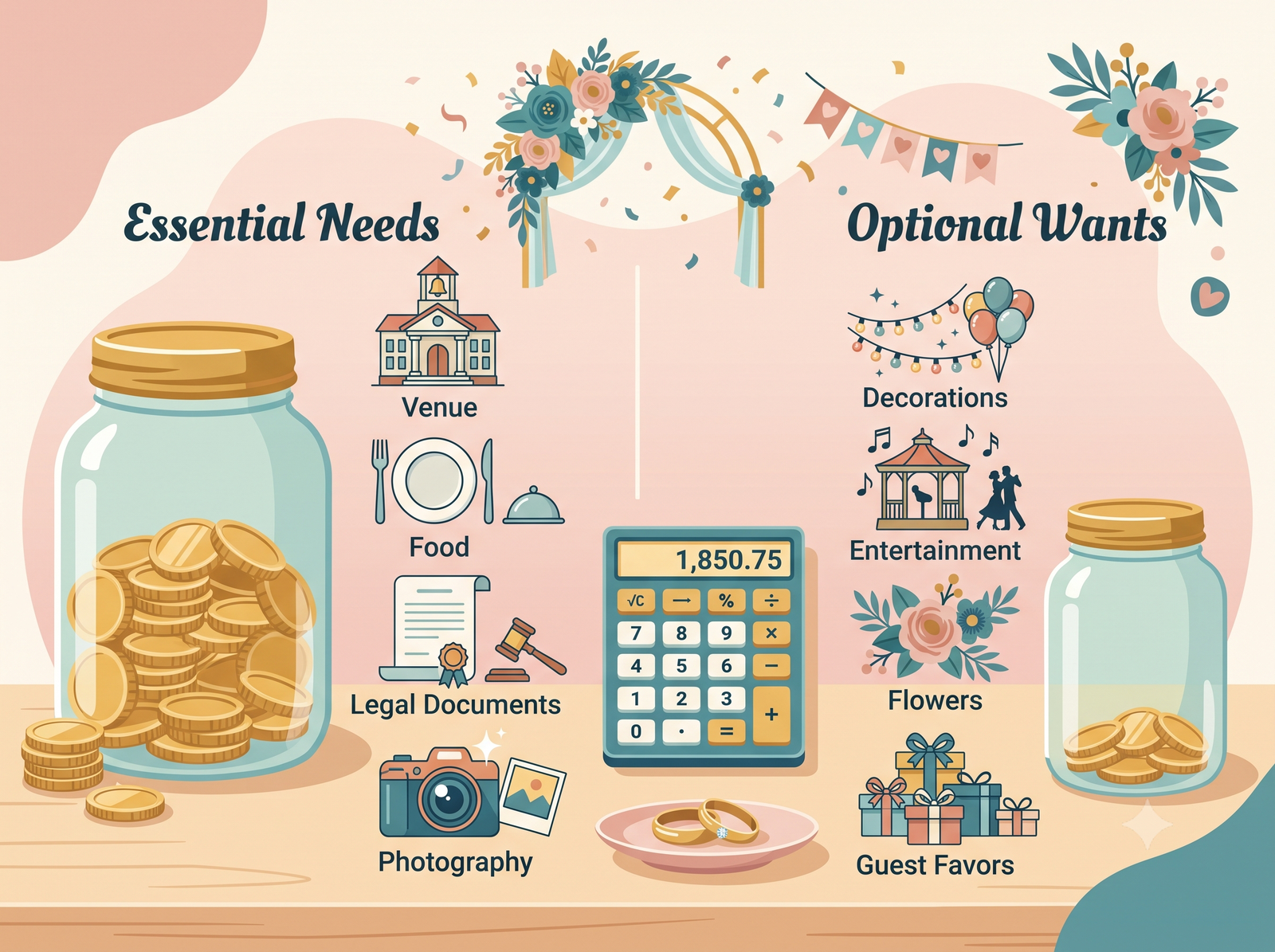
Some wedding expenses may be necessary for the event to function:
- Legal or administrative requirements
- Basic venue
- Food
- Seating
- Required transportation
- Appropriate clothing
- Essential photography or documentation
- Accessibility needs
Other expenses may improve the appearance or experience but are optional:
- Luxury upgrades
- Premium decorations
- Large floral arrangements
- Designer clothing
- Extra entertainment
- Guest favors
- Multiple events
- Expensive transportation
- Specialty desserts
- Elaborate invitations
There is no universal list of needs and wants. The important question is what matters to you and what can be removed without damaging the meaning of the event.
Use the framework in needs versus wants to separate the basic purpose from optional features.
Prioritize the Most Meaningful Parts
Choose the three to five parts of the wedding that matter most to you and your partner.
Your priorities may include:
- Family and guests
- Food
- Music
- Photography
- A specific venue
- Religious or cultural traditions
- Clothing
- A small guest list
- Outdoor setting
- Travel
- A relaxed atmosphere
Spend more intentionally on these priorities and reduce spending elsewhere.
For example, if photography matters most, you may choose simpler decorations. If food is the priority, you may use a less expensive venue. If family attendance matters most, you may choose a smaller local event instead of an expensive destination.
A wedding does not need to maximize every category.
Create a Detailed Wedding Budget
Use categories rather than one large total.
| Category | Estimated Budget |
|---|---|
| Venue | $3,000 |
| Food and drinks | $3,500 |
| Clothing | $1,200 |
| Photography | $1,000 |
| Decorations and flowers | $700 |
| Music or entertainment | $700 |
| Invitations and stationery | $250 |
| Transportation | $400 |
| Legal or administrative costs | $250 |
| Emergency buffer | $1,000 |
| Total | $12,000 |
The categories will vary based on location, guest list, traditions, and preferences.
Include an emergency buffer. Unexpected costs may involve:
- Additional guests
- Delivery fees
- Alterations
- Weather changes
- Vendor charges
- Transportation
- Last-minute replacements
- Overtime
A budget without a buffer can fail after one surprise expense.
Create a Separate Wedding Savings Fund
Keep wedding money separate from everyday spending where possible.
You can use:
- A dedicated savings account
- A bank sub-account
- A spreadsheet category
- A digital envelope
- A shared goal tracker
A separate category helps prevent confusion between:
- Wedding savings
- Emergency funds
- Rent
- Debt repayment
- Regular spending
If you are saving as a couple, agree on:
- How much each person contributes
- Whether contributions are equal or proportional
- Who can withdraw money
- What happens if plans change
- How family contributions are recorded
- How the fund is protected
Transparency matters. Both people should understand the total amount available and the major commitments being made.
Save Automatically Each Month
Automatic transfers can make wedding saving more consistent.
Schedule a transfer after income arrives. The amount should be realistic after covering:
- Housing
- Food
- Transportation
- Debt payments
- Healthcare
- Emergency savings
- Other essential expenses
If income varies, save a conservative base amount and direct part of extra income toward the wedding.
You can also use a percentage system:
- Fixed monthly contribution from regular income
- A percentage of bonuses or overtime
- A portion of gifts
- Money from selling unused items
- Extra freelance income
Do not rely on irregular income until it is actually received.
Reduce the Guest List Carefully
The number of guests often affects several parts of the budget at once.
A smaller guest list may reduce:
- Food
- Drinks
- Seating
- Invitations
- Table settings
- Transportation
- Venue size
- Photography time
- Accommodation
- Favors
Reducing the guest list can be emotionally difficult, especially when families have strong expectations.
Discuss:
- Who must be invited
- Whether children are included
- Plus-one rules
- Family traditions
- Work colleagues
- Ceremony and reception differences
- A maximum guest number
Set the guest limit before making other decisions. Adding guests later can create costs across multiple categories.
Compare Vendors Carefully
When comparing vendors, look beyond the base price.
Ask about:
- Deposits
- Payment schedule
- Taxes
- Service charges
- Delivery
- Setup and removal
- Overtime
- Cancellation
- Refunds
- Additional guests
- Equipment
- Gratuities
- Replacement arrangements
The least expensive quote may not be the lowest total cost if it excludes necessary services.
Request written details. Keep contracts, receipts, payment records, and deadlines in one place.
Avoid paying large nonrefundable amounts before understanding the terms.
Use Alternatives to Reduce Costs
You may reduce costs through:
- A weekday or off-season event
- A smaller venue
- A community hall
- A family-owned location
- Digital invitations
- Borrowed decorations
- Secondhand clothing
- Renting formalwear
- Local food providers
- A shorter reception
- A playlist instead of a live band
- Seasonal flowers
- Simple centerpieces
- A family photography contribution
- Combined ceremony and reception
Choose alternatives that preserve your priorities.
Do not accept free or borrowed help without discussing expectations, timing, quality, and backup plans.
Discuss Family Contributions Clearly
Family support can be helpful, but unclear expectations may create conflict.
Ask:
- How much will be contributed?
- When will it be available?
- Is it a gift or a loan?
- Does the contributor expect decision-making authority?
- Will the money be used for a specific category?
- What happens if the amount changes?
Put important agreements in writing, even if the conversation feels uncomfortable.
Do not build a budget around vague promises such as:
We will help with something.
Wait until the amount and timing are clear.
Protect Your Emergency Fund

Do not use every dollar of available savings for the wedding if it leaves you unable to handle an emergency.
After the wedding, you may face:
- Moving costs
- New housing
- Utility deposits
- Furniture
- Travel
- Medical expenses
- Job changes
- Debt payments
- Household repairs
A wedding is a planned event, while an emergency is an unexpected need. Both require different types of preparation.
If you do not have any emergency savings, consider building a starter buffer before increasing wedding spending.
Avoid Wedding Debt
Debt may make an expensive wedding possible today, but it creates payments after the event is over.
Before borrowing, consider:
- Total amount borrowed
- Interest rate
- Fees
- Monthly payment
- Repayment period
- Effect on future goals
- Whether both partners are responsible
- What happens if income changes
Credit card debt can become especially expensive when a balance is carried over time.
A wedding should not begin a marriage with a financial obligation that creates ongoing stress.
If the budget is too high, change the event before committing to debt.
A Realistic Wedding Savings Example
Suppose a couple wants a wedding costing $10,000.
They currently have:
- $2,000 saved
- 16 months until the event
- $8,000 remaining
They need to save:
$8,000 ÷ 16 = $500 per month
They decide to contribute:
- Partner A: $250 per month
- Partner B: $150 per month
- Extra income: Average $100 per month
The plan reaches the target only if the extra income actually occurs. To reduce risk, they create a backup plan:
- Reduce decorations by $500
- Limit the guest list
- Keep a $750 buffer
- Delay optional clothing upgrades
- Use a lower-cost entertainment option
This gives the couple more flexibility if income changes or costs rise.
Common Wedding Budget Mistakes
- Starting with a venue before setting a total budget: The venue may consume too much of the available money.
- Ignoring the guest count: Additional guests affect food, seating, invitations, and more.
- Relying on vague family promises: Count support only when the amount is clear.
- Using credit for upgrades: Small additions can become large repayment obligations.
- Forgetting deposits and fees: The advertised price may not be the final cost.
- Using emergency savings: A planned celebration should not eliminate financial protection.
- Assuming the cheapest quote is the best: Compare what each vendor includes.
- Making decisions separately: Both partners should understand major commitments.
- Leaving no contingency fund: Unexpected costs are common.
- Trying to satisfy every expectation: The wedding should reflect the couple’s priorities.
Frequently Asked Questions
How can I save for a wedding quickly?
Set a specific budget, reduce the guest list, prioritize meaningful categories, automate savings, compare vendors, and use extra income carefully. Avoid borrowing money that creates long-term stress.
How much should I save each month for a wedding?
Subtract current savings from the target cost and divide the remaining amount by the months available. If the monthly amount is too high, reduce the target or extend the timeline.
Should I use a credit card to pay for a wedding?
Using credit can create interest and repayment pressure. Avoid borrowing unless you fully understand the cost and have a realistic repayment plan.
How can couples split wedding savings?
Contributions can be equal, proportional to income, or based on an agreed arrangement. The important part is transparency and a plan both partners accept.
Should I use my emergency fund for the wedding?
An emergency fund is designed for unexpected needs, not planned celebrations. Protect at least a starter emergency buffer where possible.
How can I reduce wedding costs without making the event feel cheap?
Prioritize the categories that matter most, reduce guest numbers, compare vendors, use seasonal options, borrow or rent items, and remove upgrades that do not add meaningful value.
Are family contributions considered part of the wedding budget?
They can be included once the amount, timing, and conditions are clear. Do not rely on vague promises.
What should I do if I cannot reach my savings target?
Extend the timeline, reduce the guest list, lower optional costs, increase income, adjust the event format, or choose a smaller celebration.
Key Takeaways
- Start with a total wedding budget before choosing vendors.
- Calculate the monthly savings amount required to reach the goal.
- Separate wedding needs from optional upgrades.
- Prioritize the three to five parts of the event that matter most.
- Create a separate wedding savings category.
- Discuss family contributions clearly and record important agreements.
- Include deposits, taxes, service charges, and a contingency fund.
- Protect emergency savings and avoid high-cost wedding debt.
- Review vendor contracts carefully before paying.
- Readers can continue with goal-based saving, what is a sinking fund, and how to set financial goals.
- Those who struggle with unplanned purchases can also read how to stop impulse spending.
A meaningful wedding does not require spending more than you can afford. The most useful plan is one that allows you to celebrate while protecting the financial life you are building together.
Set the budget first, save consistently, prioritize what matters, and make changes early when the numbers do not work. A smaller celebration paid for intentionally may create more lasting peace than a larger event financed through years of repayment.
This article is for informational purposes only and is not financial advice.
Leave a Reply
You must be logged in to post a comment.