
Emotions are a normal part of investing, but they can create problems when they control every decision.
Fear may encourage you to sell after a decline. Excitement may cause you to buy after a sharp rise. Anxiety may lead you to check your account constantly, while overconfidence may encourage unnecessary risk.
The goal is not to become completely emotionless. That is impossible. The goal is to create a process that reduces the number of decisions you make during moments of fear, excitement, or uncertainty.
This guide explains how to remove emotion from investing by creating clear goals, separating short-term money, automating suitable actions, limiting unnecessary monitoring, and reviewing your plan at regular intervals.
Investing involves risk. This article is general education and not a recommendation to buy, sell, or hold any specific investment.
Why Emotional Investing Happens
Investing creates uncertainty because future outcomes are not known.
You may experience emotions when:
- Prices rise quickly
- Prices fall sharply
- A friend reports a large gain
- A financial headline predicts disaster
- You worry about losing savings
- You feel pressure to act immediately
- You regret a previous decision
- You compare your results with others
These reactions are understandable. Money may represent housing, education, retirement, family security, or future independence.
Emotional investing becomes a problem when the reaction causes you to abandon a suitable plan without reviewing the full situation.
Common emotional decisions include:
- Buying because everyone else is buying
- Selling because the latest price fell
- Investing more than you can afford
- Changing strategies repeatedly
- Holding something only because you dislike realizing a loss
- Avoiding all investment risk
- Checking your account constantly
Our article on the psychology of investing explains why intelligent people can still make poor investment decisions under emotional pressure.
Start With a Clear Financial Goal
A routine is easier to follow when you know what the money is for.
Possible goals include:
- Retirement
- Education
- A home
- A business
- Long-term family support
- Financial independence
- Another distant life goal
Write down:
- Goal
- Amount needed
- Time horizon
- Current savings
- Regular contribution
- Acceptable level of uncertainty
- Conditions that would require a review
Do not use one investment approach for every goal. Money needed soon may require more stability and access than money intended for a distant objective.
A clear goal also helps you ignore distractions. If an investment does not support your purpose, its popularity may not matter.
Separate Short-Term Money From Long-Term Money
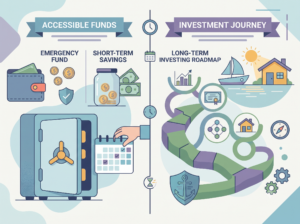
Emotional decisions become more likely when money is invested that should have remained available for immediate needs.
Separate money for:
- Rent
- Tuition
- Medical expenses
- Emergency repairs
- A planned move
- Annual bills
- Near-term purchases
from money intended for longer-term goals.
If you need to sell an investment quickly to pay an essential bill, a short-term price decline may create serious pressure.
An emergency fund can help protect long-term investments from short-term financial problems. The appropriate amount depends on income stability, household responsibilities, expenses, and access to other support.
This separation does not remove investment risk, but it can reduce the need to make decisions under urgent pressure.
Create Written Investment Rules
A written plan can act as a guide when emotions become strong.
Your rules might address:
- How often you contribute
- How often you review the plan
- What percentage of money may be placed in one investment
- What information must be checked before making a change
- What events justify a review
- What actions you will avoid during panic
- How you will handle a major life change
Example rules might include:
- I will not invest money needed within the next year.
- I will wait before making a major change after a dramatic price movement.
- I will review the plan twice a year.
- I will not buy an investment I cannot explain.
- I will not use borrowed money for an unfamiliar investment.
- I will review both positive and negative evidence.
- I will not change the plan based on one social media post.
The purpose is not to create rigid rules that ignore reality. It is to prevent temporary emotions from becoming automatic instructions.
Automate Regular Contributions
Automation may help reduce emotional timing decisions.
A scheduled contribution can:
- Encourage consistency
- Reduce the temptation to wait for a perfect moment
- Limit reactions to headlines
- Make saving part of a routine
- Reduce the number of times you must decide whether to act
Automation should be based on a plan that fits your income and essential expenses.
Review:
- Contribution amount
- Account fees
- Investment choices
- Risk level
- Time horizon
- Changes in income
- Changes in financial responsibilities
Do not automate an amount that prevents you from paying bills or building emergency savings.
Automation is a tool, not a guarantee of success. It still requires periodic review.
Use a Regular Review Schedule

Checking investments every day can increase emotional reactions. Instead, choose a review schedule appropriate for your goals.
During a review, consider:
- Is the goal still the same?
- Is the time horizon unchanged?
- Are contributions affordable?
- Has your income changed?
- Has your emergency fund changed?
- Are fees still understood?
- Is the investment still suitable?
- Has your risk capacity changed?
- Is the portfolio too concentrated?
A review is different from reacting to every price change.
You may choose a monthly, quarterly, or twice-yearly review depending on your needs. The best schedule is one that keeps you informed without encouraging unnecessary activity.
Limit Financial Noise
Financial content can be useful, but constant exposure may make investing feel like an emergency.
Consider limiting:
- Price notifications
- Breaking-news alerts
- Online arguments
- Prediction videos
- Influencer content
- Repeated market commentary
- Unverified group messages
- Sensational headlines
Use a small number of reliable sources and read complete information when possible.
Before acting on a claim, ask:
- Is this fact or prediction?
- Who benefits if I act?
- Are risks explained?
- Is the information current?
- Does it change my personal plan?
- Would I act without the urgency?
An investment routine should leave room for thoughtful review rather than constant reaction.
Use a Decision Journal
Before buying or selling, write down:
- The decision
- The reason
- The information used
- The risks
- The expected outcome
- The time horizon
- What would change your view
- How you feel at the moment
If you feel panicked or euphoric, record that emotion. It may be a sign that waiting would be useful.
Review the journal later. You may notice patterns such as:
- Buying after recent gains
- Selling after headlines
- Following friends
- Ignoring negative information
- Taking too much risk when excited
- Avoiding reasonable opportunities after losses
A journal helps you evaluate the process rather than judging yourself only by the outcome.
Build Diversification and Risk Limits
Concentration can intensify emotional reactions because the outcome of one investment affects a large portion of your finances.
Diversification may involve spreading exposure across:
- Companies
- Industries
- Asset categories
- Geographic areas
- Investment styles
- Time periods
Diversification does not guarantee profit or prevent losses. It may reduce dependence on a single outcome.
You may also create personal risk limits, such as:
- Maximum exposure to one investment
- Maximum amount for speculative ideas
- No borrowing for investments
- No use of emergency savings
- No investment that cannot be explained
The appropriate limits depend on your situation and should be realistic enough to follow.
Create a Rule for Market Declines
A market decline can feel like a command to act. Decide in advance what you will do when prices fall.
Your process might be:
- Wait before making a major change.
- Review the original goal and timeline.
- Check whether your personal situation changed.
- Review the investment’s risk and information.
- Avoid social-media-driven decisions.
- Consult a qualified professional if the decision is significant.
- Make a change only when the overall plan no longer fits.
This does not mean you must always hold an investment during a decline. It means you avoid acting purely because fear is intense.
See loss aversion in investing for more on why losses can feel stronger than gains.
A Realistic Investing Routine Example
Imagine a person investing for a long-term goal.
They create the following routine:
- Transfer a fixed amount after each paycheck
- Keep emergency savings in a separate account
- Review the plan every three months
- Read a small number of reliable sources
- Avoid price alerts
- Write down major decisions
- Check fees and diversification twice a year
- Revisit the plan after a job change or major family event
During a market decline, the person does not automatically sell. They review the goal, time horizon, emergency savings, and risk level.
Later, their circumstances change because they need the money sooner than expected. The person reviews the plan and considers an adjustment based on the changed timeline, not merely on a headline.
The routine does not eliminate uncertainty. It reduces the number of decisions made impulsively.
Common Mistakes When Building an Investing Routine
- Automating without reviewing: A routine can become unsuitable when your life changes.
- Checking prices constantly: Frequent monitoring creates unnecessary emotional noise.
- Using a rigid plan: A routine should adapt to major changes in income and goals.
- Ignoring fees: Small fees can affect long-term results.
- Investing emergency savings: Short-term money may need accessibility.
- Following online predictions: Confidence does not make a forecast certain.
- Changing everything after one loss: A decline should be evaluated in context.
- Taking more risk to recover quickly: This can increase the damage.
- Using borrowed money: Debt can make volatility more dangerous.
- Failing to document decisions: Without a record, emotional patterns are harder to identify.
Frequently Asked Questions
Can you completely remove emotion from investing?
No. Emotions are a normal part of decision-making. You can reduce their influence by using written rules, automation, scheduled reviews, and limits.
What is the best investing routine for beginners?
Start with a clear goal, separate short-term savings from long-term money, understand fees and risk, contribute only what you can afford, and review the plan periodically.
Should I check my investments every day?
Daily checking is not necessary for many long-term goals and may increase emotional reactions. Choose a review schedule that fits the goal and your circumstances.
Does automation make investing safer?
Automation can reduce emotional timing decisions, but it does not remove market risk. Review the amount, account, fees, and risk periodically.
What should I do during a market decline?
Pause, review your goal and timeline, consider whether your personal circumstances changed, and avoid making a decision based solely on panic.
How can a decision journal help?
It records why you made a decision, what evidence you used, and how you felt. Reviewing it later can reveal repeated emotional patterns.
Should I diversify everything?
Diversification can reduce dependence on one investment, but it does not eliminate risk. The suitable approach depends on your goals, time horizon, and circumstances.
When should I change an investment plan?
Consider a review after major changes in income, goals, timeline, dependents, debt, emergency savings, or risk capacity. Do not change solely because of one short-term price movement.
Key Takeaways
- Emotional investing is difficult to eliminate, but systems can reduce its influence.
- Begin with a clear goal, time horizon, and realistic contribution.
- Separate emergency money and short-term expenses from long-term investment money.
- Use written rules before fear or excitement appears.
- Automate suitable contributions, but review them periodically.
- Limit price alerts and sensational financial content.
- Use a decision journal to recognize repeated patterns.
- Diversification and risk limits can reduce concentration and emotional pressure.
- Review plans after meaningful life changes rather than reacting to every market headline.
- Readers can continue with the psychology of investing, loss aversion in investing, and recency bias in investing.
- Those working on future financial goals can also read goal-based saving.
Removing emotion from investing does not mean becoming indifferent to your money. It means creating a process that lets you respond thoughtfully instead of reacting immediately.
A clear goal, scheduled contributions, limited monitoring, and regular reviews can make investing more manageable. Your process should be flexible enough to reflect real changes in your life while protecting you from decisions driven only by fear, excitement, or social pressure.
This article is for informational purposes only and is not investment advice.
Leave a Reply
You must be logged in to post a comment.