
Investing can feel easier when many other people appear to be making the same decision.
A popular investment is discussed online, prices rise quickly, friends share gains, and financial content becomes difficult to avoid. You may begin to think:
- Everyone else must know something I do not
- This opportunity will disappear if I wait
- The price is rising, so it must be safe
- I should buy before it goes higher
- If many people are doing it, I cannot be wrong
This is herd mentality in investing: the tendency to follow the actions of a group instead of making an independent decision based on your own goals, risk, and information.
Following others is not always irrational. Groups can sometimes identify useful information. The problem occurs when popularity replaces analysis and social pressure becomes the main reason for buying or selling.
This guide explains herd mentality in investing, why investors follow trends, how social proof affects decisions, why crowded investments can become risky, and how to create a calmer process for independent decision-making.
Investments involve risk, and this article is general education rather than individualized investment advice.
What Is Herd Mentality in Investing?
Herd mentality occurs when people copy the behavior of a group, often because they believe the group has better information or because following others feels safer than making an independent decision.
In investing, herd behavior may involve:
- Buying a popular asset after a sharp rise
- Selling because other investors are panicking
- Following online personalities
- Copying friends or coworkers
- Chasing a trend without understanding it
- Assuming a crowded trade must be safe
- Ignoring personal goals and risk limits
The behavior can happen among beginners and experienced investors.
Professional investors may also feel pressure to follow a benchmark, industry trend, or popular strategy. The difference is that they may have systems designed to identify and manage that pressure.
Herd mentality is not simply “doing what everyone else does.” It is allowing group behavior to replace your own evaluation.
Why People Follow the Crowd
Social Proof
People often use other people’s behavior as evidence that a decision is correct.
If thousands of people appear to be buying something, the popularity itself can feel persuasive.
Fear of Missing Out
A rising price can create urgency:
- What if I miss the opportunity?
- What if everyone else becomes wealthy?
- What if I wait too long?
- What if this is the next major trend?
Fear of missing out can make people skip research and act quickly.
Uncertainty Reduction
Investing involves incomplete information. Following others can feel like a shortcut through uncertainty.
Instead of asking whether an investment fits your plan, you may ask whether other people appear confident.
Belonging
People may want to participate in conversations with friends, coworkers, online groups, or communities.
Owning the same investment can create a sense of belonging, even when the decision is not suitable financially.
Regret Avoidance
Buying after others have gained can feel safer than being left behind. People may fear regretting the decision not to participate more than they fear the possibility of losing money.
How Herd Mentality Can Push Prices
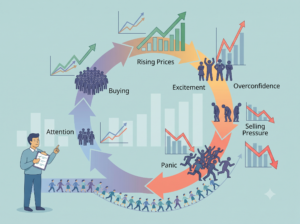
When many people buy at the same time, demand may increase and prices may rise.
The rising price then attracts more attention, which may encourage additional buying.
A simplified cycle can look like this:
- An investment receives attention.
- Early buyers purchase it.
- The price rises.
- More people notice the rise.
- Social proof encourages new buyers.
- Confidence becomes excitement.
- Buyers ignore risk.
- Negative news or selling pressure appears.
- The crowd begins selling.
- The price falls quickly.
This cycle does not occur in every popular investment. A rising price may reflect genuine improvements in a business or economic conditions.
The warning sign is not popularity alone. The concern is when people buy mainly because the price is rising and others are buying.
Why Crowded Investments Can Become Risky
A popular investment may have:
- High expectations
- A large amount of speculative money
- Limited diversification
- Inflated valuations
- Strong dependence on public confidence
- Significant volatility
- Sudden changes in demand
If expectations are already very high, even good news may not be enough to support the price. If new buyers stop arriving, the momentum can weaken.
Crowded investments may also create concentration risk. If too much of your financial future depends on one trend, company, industry, or asset type, a reversal may have a larger effect on your finances.
A popular investment is not automatically bad. It simply deserves independent analysis rather than automatic trust.
Social Media and Investment Herds
Social media can intensify herd behavior because it spreads:
- Price updates
- Screenshots of gains
- Strong opinions
- Short videos
- Predictions
- Memes
- Testimonials
- Urgent calls to action
Social content often rewards confidence and excitement more than uncertainty and careful research.
You may see someone sharing a successful trade but not:
- Their losing trades
- Their total account size
- Their debt
- Their risk exposure
- Their financial support
- Their reason for selling
- Their tax position
- Their long-term plan
A screenshot does not tell you whether the decision is suitable for your own situation.
Before acting on financial content, ask:
- Is the person qualified?
- Do they disclose conflicts?
- Are they selling something?
- Is the information supported by evidence?
- Are risks discussed?
- Is the content designed to create urgency?
- Would I make this decision without seeing the post?
Questions to Ask Before Following a Trend
Use a written checklist before buying a popular investment.
Ask:
- What exactly am I buying?
- How does it create value?
- What risks could cause a loss?
- What is the time horizon?
- How easily can I sell it?
- How much of my portfolio would it represent?
- What fees apply?
- Am I using borrowed money?
- What evidence supports the decision?
- What evidence challenges it?
- Would this still fit my plan if the price stopped rising?
- What is the most I could reasonably lose?
If you cannot explain the investment in simple language, you may not understand it well enough to make a confident decision.
Understanding does not eliminate risk, but it reduces the chance that popularity is your only reason for buying.
Create Personal Investment Rules

Rules can help protect you from emotional decisions.
Possible rules include:
- I will wait before buying after a sharp price increase
- I will not invest money needed for essential expenses
- I will not use borrowed money for an unfamiliar investment
- I will limit exposure to a single speculative idea
- I will review fees before investing
- I will write down why I am buying
- I will set a review date
- I will not sell solely because of one alarming headline
- I will avoid investments I cannot explain
- I will not make decisions during emotional conversations online
Your rules should reflect your goals and risk tolerance. A rule is useful only if you can follow it.
Build Diversification Into Your Plan
Diversification means spreading exposure across different investments or categories rather than depending on one outcome.
It may help reduce the effect of a problem in one investment, but it cannot eliminate market risk.
Diversification can involve differences in:
- Companies
- Industries
- Geographic areas
- Asset types
- Time periods
- Investment strategies
Do not assume that owning several investments automatically creates diversification. Several investments may still be concentrated in the same industry or theme.
If a popular trend becomes a large portion of your finances, review whether that concentration is intentional and suitable.
Avoid Buying Only Because the Price Is Rising
A rising price can attract buyers, but price movement alone does not explain value.
Ask:
- What changed?
- Is the increase based on earnings, cash flow, assets, or another measurable factor?
- Is the price supported by evidence?
- Is the trend dependent on constant new buyers?
- What happens if expectations change?
Avoid assuming that a price will continue rising simply because it has risen recently. This connects with recency bias in investing, where recent performance feels more important than the longer-term picture.
A price increase may continue, stop, or reverse. No single recent pattern guarantees the next result.
Understand the Difference Between Information and Advice
Information may explain:
- What an investment is
- How a market works
- Historical performance
- Possible risks
- Fees
- Regulatory details
Advice tells you what to buy, sell, or hold.
Online content may present opinions as certainty. Be cautious of phrases such as:
- Cannot lose
- Guaranteed returns
- Buy before it is too late
- Everyone is getting rich
- This is the next sure winner
- Risk-free opportunity
- Guaranteed approval or profit
Legitimate investment decisions involve uncertainty. A person who guarantees a result may be ignoring important risks or trying to sell a product.
A Realistic Herd Mentality Example
Imagine an investment becomes popular online after rising sharply over several months.
A person sees friends posting gains and buys without reviewing:
- What the investment represents
- How volatile it is
- Whether it fits their goals
- How much of their savings it would use
- What could cause a decline
The price rises briefly, encouraging the person to buy more. Later, negative news appears and the price falls quickly.
The person panics and sells at a loss.
A more independent process would have involved:
- Waiting before acting
- Reading reliable information
- Limiting the position size
- Keeping emergency savings separate
- Understanding the downside
- Writing down the reason for buying
- Reviewing the investment according to a schedule
The goal is not to predict the price perfectly. It is to make a decision that remains reasonable even if the crowd changes direction.
Common Herd Mentality Investing Mistakes
- Buying after a dramatic rise: Recent growth may create unrealistic expectations.
- Following social media screenshots: You rarely see the complete financial context.
- Using borrowed money: Leverage can increase losses and pressure.
- Ignoring diversification: One trend should not control your financial future.
- Confusing popularity with quality: Many people can repeat the same mistake.
- Selling during crowd panic: Fear can be just as contagious as excitement.
- Skipping research: A confident headline is not a complete analysis.
- Investing because friends insist: Their goals and risk may differ from yours.
- Making decisions under time pressure: Urgency is often part of the sales strategy.
- Treating predictions as facts: Forecasts are uncertain, even when delivered confidently.
Frequently Asked Questions
What is herd mentality in investing?
Herd mentality is the tendency to follow a group’s buying or selling behavior instead of making an independent decision based on your own goals, risk, and research.
Why do investors follow trends?
Investors may follow trends because of social proof, fear of missing out, uncertainty, belonging, excitement, or fear of regretting a decision.
Is it always bad to follow other investors?
Not necessarily. Other investors may provide useful information, but copying them without understanding the investment or considering your own situation can create problems.
How can I avoid herd behavior?
Use a written checklist, delay decisions after dramatic price movements, research both positive and negative evidence, diversify appropriately, and avoid using borrowed money.
Is a popular investment automatically risky?
No. Popularity alone does not determine risk. However, a crowded investment may have high expectations, volatility, or concentration risk that deserves careful review.
Should I buy an investment after it rises sharply?
Do not decide based only on the price increase. Understand what caused the rise, the risks involved, and whether the investment fits your goals and time horizon.
How does social media affect investing?
Social media can amplify excitement, urgency, predictions, and visible success stories while hiding losses, fees, debt, and other risks.
What should I do if I already followed a trend?
Review what you own, understand the risk, check how much of your finances it represents, and avoid making another emotional decision. Consider qualified advice if the position is significant or difficult to understand.
Key Takeaways
- Herd mentality occurs when investors follow group behavior instead of making independent decisions.
- Social proof and fear of missing out can make popularity feel like evidence.
- A rising price does not guarantee that an investment is safe or suitable.
- Social media often shows selected gains without showing the full financial context.
- Use a checklist before buying a popular investment.
- Research both supporting and challenging information.
- Avoid using borrowed money for unfamiliar or highly speculative investments.
- Diversification can reduce dependence on one company, industry, or trend.
- Written rules and delayed decisions can reduce emotional investing.
- Readers can continue with the psychology of investing, loss aversion in investing, and recency bias in investing.
- Those wanting a structured approach can read how to remove emotion from investing.
Following a crowd can feel safer because you are not making the decision alone. But the crowd does not know your income, responsibilities, goals, time horizon, or ability to handle a loss.
Use other people’s opinions as information, not as a substitute for your own decision process. Slow down when excitement and urgency are highest, understand what you are buying, and choose an approach that fits your financial life even when the crowd changes direction.
This article is for informational purposes only and is not investment advice.
Leave a Reply
You must be logged in to post a comment.