
A market can rise for several months and make investors believe that prices will continue rising. It can then fall sharply for a few weeks and make those same investors believe that the decline will never end.
This tendency is known as recency bias.
Recency bias occurs when people give more importance to recent events than to older information, long-term patterns, or their original financial plan.
In investing, recency bias can lead to:
- Buying after recent gains
- Selling after recent losses
- Changing a long-term strategy because of one news cycle
- Treating recent performance as a prediction
- Ignoring historical uncertainty
- Checking investments too often
- Assuming current conditions will continue indefinitely
This guide explains recency bias in investing, why recent events feel so powerful, how short-term news affects decisions, and what practical systems can help you maintain a longer-term perspective.
Investing involves risk, and this article is general education rather than personalized investment advice.
What Is Recency Bias?
Recency bias is the tendency to use recent events as though they are more representative or predictive than they really are.
For example:
- A few months of strong returns may make an investment seem permanently safe
- A short market decline may make long-term investing seem pointless
- A recent loss may cause you to avoid an entire asset category
- A newly popular trend may seem more important than years of information
The recent event is not imaginary. It happened. The problem is giving it more weight than it deserves.
Recency bias affects everyday decisions too. If a restaurant was excellent last week, you may assume it is always excellent. If a product failed recently, you may assume the brand is always unreliable.
In investing, the consequences can be larger because decisions involve real money and long time horizons.
Why Recent Events Feel So Powerful
Recent Information Is Easier to Remember
A market move from yesterday is easier to recall than a pattern from ten years ago.
News Repeats the Same Story
Financial media may discuss the same market movement across television, websites, social media, and notifications. Repetition can make the event feel larger.
Recent Results Feel More Personal
If you see your account fall this week, the loss feels immediate. A long-term goal many years away can feel less real.
Uncertainty Encourages Shortcuts
When people feel uncertain, they often use the most available information to make a quick judgment.
Humans Look for Patterns
The brain naturally searches for trends. A few recent positive or negative events can appear to form a clear direction even when the longer-term information is mixed.
Recognizing these tendencies can help you pause before changing your investment plan.
How Recency Bias Affects Buying Decisions
Buying After Strong Performance
When an investment rises recently, investors may assume:
- It is safer than it used to be
- The rise will continue
- They need to act immediately
- Other people have discovered a secret
- Waiting means missing the opportunity
This can lead to buying after expectations have already become very high.
Avoiding an Investment After a Decline
After losses, people may conclude:
- The investment is permanently broken
- All investments are too dangerous
- The market will continue falling
- Saving cash is always safer
- Investing should be postponed indefinitely
Avoiding a decision because of recent losses can be understandable, but the conclusion may be broader than the evidence supports.
Switching Strategies Repeatedly
Some investors change their approach whenever a different asset or strategy has recently performed better.
This can result in:
- Buying high
- Selling low
- Higher fees
- More taxes where applicable
- Confusion
- No consistent plan
- Difficulty measuring progress
A strategy should be evaluated over a period that matches its purpose, not only over the last few weeks.
Recent Performance Is Not a Complete Forecast
Past performance may provide information, but a recent result does not guarantee what happens next.
Ask:
- What caused the recent movement?
- Is the change temporary or structural?
- Does it affect the long-term goal?
- Are expectations already reflected in the price?
- What risks have increased?
- What evidence would challenge my interpretation?
- Am I reacting to one event?
A recent rise may be caused by changing expectations, unusual conditions, speculation, or genuine improvements. A recent fall may result from short-term uncertainty, a serious problem, or a broader market movement.
The explanation matters more than the direction alone.
Avoid treating a recent chart as a complete investment analysis.
Separate News From Your Financial Plan
Financial news may be relevant, but not every headline requires action.
Before changing your plan, ask:
- Has my goal changed?
- Has my time horizon changed?
- Has my income changed?
- Has my emergency fund changed?
- Has the investment’s risk changed?
- Did the news affect the underlying situation?
- Am I reacting because the headline is dramatic?
- Would I make this decision if I had not seen the headline?
This does not mean ignoring important information. It means determining whether the information has practical significance for your situation.
A long-term plan should not be changed simply because a short-term headline creates fear or excitement.
Use a Longer Review Period
One way to reduce recency bias is to review information across several periods.
Instead of looking only at:
- Last week
- Last month
- The current quarter
also review:
- One year
- Several years
- The entire period of your goal
- The original assumptions behind the decision
The appropriate period depends on the investment and objective. A short-term goal requires closer attention to near-term conditions, while a distant goal may require more focus on long-term suitability.
Do not use historical performance as a promise. Use it as context.
Create a Decision Journal

Before making a major investment change, write down:
- What decision am I considering?
- What recent event triggered it?
- What is my goal?
- What is my time horizon?
- What evidence supports the decision?
- What evidence challenges it?
- What risks am I accepting?
- What would make me change my mind?
- What outcome do I expect?
- How will I review this decision later?
Review the journal after several months.
You may discover that your confidence was based mostly on recent news rather than a complete analysis. The journal can also help you recognize patterns in your own behavior.
Writing creates distance between the emotional reaction and the financial decision.
Limit Financial News Exposure
Constant exposure to financial updates can make short-term movement feel urgent.
Consider:
- Turning off price notifications
- Checking investments on a schedule
- Choosing a few reliable information sources
- Avoiding sensational predictions
- Reducing social media investment content
- Reading full explanations rather than headlines
- Taking a break during highly emotional periods
You do not need to avoid information entirely. You need to avoid allowing every update to control your decision-making.
A useful question is:
Does this information change what I should do, or does it only change how I feel?
If it changes only your feelings, waiting may be helpful.
Understand Your Time Horizon
Time horizon is the period before you need the money.
A short-term goal may include:
- Tuition
- Rent
- A vehicle purchase
- A planned move
- Emergency expenses
- A scheduled payment
A long-term goal may include:
- Retirement
- A distant education goal
- Long-term wealth building
- A future family objective
The shorter the time horizon, the less room there may be to wait through significant declines.
A longer time horizon does not guarantee a positive result, but it may provide more opportunity to manage temporary movements.
Recency bias can cause investors to treat every goal as if it were immediate. Keep the timeline visible when reviewing your decisions.
Use Automatic Contributions Carefully
Regular contributions can reduce the temptation to make a new decision based on every recent market move.
Automation may help you:
- Follow a schedule
- Avoid waiting for a perfect entry point
- Reduce emotional timing decisions
- Maintain consistency
- Focus on the goal rather than daily prices
Automation should still be reviewed when your income, expenses, risk tolerance, or objectives change.
Do not automate an amount that prevents you from covering essential expenses or building emergency savings.
The purpose is to support a suitable plan, not to make investing completely automatic and unexamined.
A Realistic Recency Bias Example
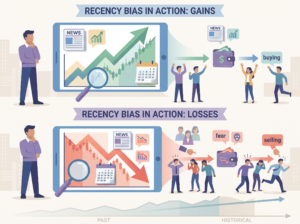
Imagine an investor whose portfolio performed well during the previous year. They begin to believe that similar returns are likely to continue and decide to move more money into the same investment.
Soon afterward, the investment declines. The investor becomes convinced that the entire strategy is failing and considers selling everything.
Both decisions are based heavily on recent performance:
- The first decision gives too much weight to recent gains
- The second gives too much weight to recent losses
A more thoughtful review would consider:
- The original goal
- Time horizon
- Diversification
- Risk level
- Fees
- Emergency savings
- Current financial responsibilities
- Whether the underlying investment has changed
The investor may still decide to adjust the plan, but the decision would be based on more than the latest price movement.
Recency Bias and Other Investing Errors
Recency bias often works together with other psychological patterns.
Herd Mentality
Recent gains attract a crowd, which makes the investment seem even more attractive. See herd mentality in investing.
Loss Aversion
Recent losses may feel so painful that selling seems like the only way to regain control. See loss aversion in investing.
Overconfidence
A recent successful decision may make investors believe they can predict future movements.
Confirmation Bias
Investors may search for recent news that supports the decision they already want to make.
Understanding these connections can help you recognize when several emotional influences are operating at once.
Common Recency Bias Mistakes
- Assuming recent gains will continue: Good performance is not a guarantee.
- Selling after one short decline: A temporary movement may not change the long-term goal.
- Changing strategies repeatedly: Constant switching can create costs and confusion.
- Checking investments every day: Frequent monitoring increases emotional reactions.
- Treating headlines as analysis: A dramatic headline may omit important context.
- Ignoring the time horizon: Short-term movement means different things for different goals.
- Buying the most popular recent investment: Popularity can increase concentration and risk.
- Using past returns as expected income: Future results are uncertain.
- Forgetting your original plan: A new emotion can replace the reason you invested.
- Making decisions during panic: Wait and review the full situation.
Frequently Asked Questions
What is recency bias in investing?
Recency bias is the tendency to give too much importance to recent events when making decisions, even when those events may not represent the longer-term situation.
How does recency bias affect investors?
It can cause investors to buy after recent gains, sell after recent losses, change strategies frequently, and overreact to short-term financial news.
Is recent market performance useful?
It can provide information, but it should be considered alongside goals, risk, time horizon, fees, diversification, and longer-term context.
How can I avoid overreacting to market news?
Limit unnecessary notifications, use a written decision process, wait before acting, review your time horizon, and ask whether the news changes your plan or only your emotions.
Should I stop checking my investments?
Not necessarily. Choose a review schedule that fits your goals and avoids constant monitoring. Focus on meaningful changes rather than daily noise.
Should I change my investment strategy after a major market move?
Review the reason for the move and your personal circumstances first. Do not change strategy solely because the recent result feels uncomfortable or exciting.
Can automation reduce recency bias?
Regular contributions and scheduled reviews may reduce emotional timing decisions, but automation still needs periodic review to ensure it fits your goals and budget.
How is recency bias different from herd mentality?
Recency bias focuses on giving too much importance to recent events. Herd mentality focuses on following the behavior of a group. They can occur together.
Key Takeaways
- Recency bias causes recent gains or losses to feel more important than longer-term information.
- It can lead to buying after strong performance, selling after declines, and repeatedly changing strategies.
- Financial headlines may influence emotions without changing your actual financial plan.
- Review your goals, timeline, risk, and circumstances before reacting.
- Use longer review periods to place recent events in context.
- A decision journal can help separate evidence from emotion.
- Limit unnecessary notifications and sensational investment content.
- Automatic contributions may reduce emotional timing decisions.
- Readers can continue with the psychology of investing, loss aversion in investing, and herd mentality in investing.
- For a structured routine, read how to remove emotion from investing.
Recent information deserves attention, but it does not always deserve control over your decisions. The latest market move is one piece of information, not the entire story.
Before changing an investment plan, pause and review the goal, time horizon, risk, and evidence. A longer perspective cannot remove uncertainty, but it can reduce the chance that a short-term event leads to a long-term decision you did not fully consider.
This article is for informational purposes only and is not investment advice.
Leave a Reply
You must be logged in to post a comment.