
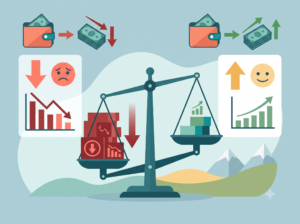
A $100 loss often feels more painful than a $100 gain feels exciting.
That emotional imbalance is known as loss aversion. It is one of the most common psychological influences on investing decisions.
Loss aversion may cause people to:
- Sell after a market decline
- Avoid investing completely
- Hold a losing investment for too long
- Take excessive risks to recover losses
- Check account balances constantly
- Focus more on avoiding pain than reaching goals
- Treat temporary price movement as permanent damage
Understanding this bias does not remove risk from investing. It can, however, help you recognize when an emotional response is influencing a financial decision.
This guide explains loss aversion in investing, why losses feel emotionally larger than gains, how the bias affects buying and selling, and which practical systems may help you make calmer decisions.
Investing involves risk, and the information here is general education rather than personalized investment advice.
What Is Loss Aversion?
Loss aversion is the tendency to feel the pain of losing something more strongly than the pleasure of gaining something of similar value.
For example, losing $100 may feel more emotionally significant than gaining $100 feels rewarding.
The exact strength of the reaction differs from person to person, but the general pattern is common.
In investing, loss aversion may cause you to focus heavily on:
- The amount your account has fallen
- The price you paid
- The possibility of further losses
- The regret of making the original decision
- What you could have bought instead
This can make normal investment uncertainty feel like a personal failure.
Loss aversion is not proof that someone is irrational. It is a natural response to uncertainty and perceived danger. The challenge is that investing often requires tolerating temporary uncertainty in pursuit of a longer-term goal.
Why Investment Losses Feel So Serious
Several factors can make losses feel especially powerful.
Losses Threaten Security
Money may represent housing, food, healthcare, education, independence, or family stability. A declining account can feel like a threat to something important.
Losses Are Easier to Notice
A falling balance is visible immediately. Long-term potential growth is abstract and distant.
Losses Create Regret
You may think:
- I should never have invested
- I should have sold earlier
- I trusted the wrong information
- I missed another opportunity
- I knew this would happen
Regret can create pressure to act quickly.
Losses Invite Social Comparison
If other people claim they sold at the top or chose a better investment, your loss may feel even worse.
Losses Feel More Certain Than Future Gains
A decline has already happened. Future recovery is uncertain. This can make selling feel emotionally safer even when it may not match your long-term plan.
How Loss Aversion Affects Investment Decisions
Selling During a Decline
An investor may sell because they want to stop feeling the pain of watching the value fall.
Selling may be appropriate in some situations, especially if the investment no longer fits the person’s goal or risk level. But selling only because of fear can turn a temporary decline into a permanent loss.
Avoiding Investment Completely
Some people avoid investing because they cannot tolerate the possibility of seeing a lower balance.
Avoiding risk can also create another risk: money intended for long-term goals may not keep pace with inflation or may fail to grow enough for the objective.
The right level of risk depends on the goal, timeline, financial position, and personal circumstances.
Holding a Losing Investment Indefinitely
Loss aversion can also create the opposite behavior. An investor may refuse to sell a poor investment because selling would make the loss feel real.
They may say:
I will sell when it gets back to what I paid.
But the original purchase price does not determine whether the investment remains suitable today.
Ask:
- Would I buy this investment now?
- Has the underlying situation changed?
- Does it still fit my goal?
- Is the risk still acceptable?
- Am I holding it only to avoid admitting a mistake?
Taking Excessive Risk to Recover
After a loss, an investor may search for a riskier opportunity to make the money back quickly.
This can lead to:
- Concentrated bets
- Frequent trading
- Speculative assets
- Borrowed money
- Unverified opportunities
- Ignoring warning signs
Trying to recover quickly can create a larger loss.
Loss Aversion and the Price You Paid
Investors often judge a decision by comparing the current value with the original purchase price.
That price is emotionally important, but it may not be the most useful decision point.
Suppose you bought an investment for $5,000 and it is now worth $4,000. The $1,000 decline feels significant.
The better question is not only:
How do I get back to $5,000?
It is also:
Is this still the most suitable place for the remaining $4,000, given my goals and risk?
If you had $4,000 in cash today, would you choose the same investment? This question can help reduce the emotional attachment to the original purchase.
The answer does not automatically mean you should sell. It simply shifts attention from past cost to current suitability.
Use a Written Investment Plan
A written plan can help you make decisions before emotions become intense.
Include:
- Financial goal
- Time horizon
- Contribution amount
- Acceptable risk
- Diversification approach
- Review schedule
- Conditions that would justify a change
- Actions you will avoid during short-term volatility
For example, your plan may state:
- I am investing for a long-term goal
- I will review the plan twice a year
- I will not make decisions based only on one news headline
- I will keep emergency savings separate
- I will reconsider the plan if my timeline or financial situation changes
A written plan does not guarantee good results. It gives you a reference point when fear or excitement makes every decision feel urgent.
This connects to the broader ideas in the psychology of investing.
Separate a Market Decline From a Personal Emergency
Not every investment loss requires immediate action.
Ask whether the decline has changed:
- Your need for the money
- Your time horizon
- Your income
- Your emergency savings
- Your debt obligations
- The investment’s purpose
- The underlying risk
- Your ability to tolerate volatility
If you need the money soon, a decline may matter more because you have less time to wait. If the goal is distant and your financial plan remains suitable, a short-term change may not require an immediate reaction.
This distinction is important because an investment loss and a personal financial emergency are not the same event.
Use Automation to Reduce Emotional Decisions

Regular contributions may reduce the temptation to make a new decision based on every market movement.
Automation can help by:
- Creating consistency
- Reducing the need to predict the best time
- Preventing money from remaining idle
- Limiting emotional decisions
- Supporting a long-term routine
Automation should still be reviewed periodically. Check that:
- The amount fits your budget
- The goal remains appropriate
- Fees are understood
- Your risk level remains suitable
- Your circumstances have not changed
Automation is not a substitute for learning or planning. It is a tool that can reduce the number of emotional decisions you make.
Limit Unnecessary Monitoring
Watching investments constantly can intensify loss aversion.
Daily checking may cause you to:
- React to normal movements
- Search for alarming predictions
- Compare yourself with others
- Trade more often
- Change your strategy repeatedly
- Feel that every decline requires action
Choose a review schedule based on your goals.
During a review, focus on:
- Contributions
- Goal progress
- Fees
- Diversification
- Risk
- Changes in personal circumstances
- Whether the original plan still makes sense
Do not confuse frequent monitoring with responsible management. Sometimes more information creates more emotional noise rather than better decisions.
A Realistic Example
Imagine an investor contributes $300 each month to a diversified long-term plan. After a period of market decline, the account value falls below the total amount contributed.
The investor feels that the strategy has failed.
Before selling, they review:
- The original time horizon
- The purpose of the money
- Whether emergency savings are separate
- Whether monthly contributions remain affordable
- Whether the risk level was understood
- Whether the investment still fits the plan
If the investor discovers that the goal is now closer than expected or the risk level is too high, they may need to reconsider the plan.
If the goal remains distant and the original assumptions are still suitable, the investor may choose to continue while monitoring the situation according to the written plan.
The correct decision cannot be determined by the loss alone. Context matters.
Common Mistakes Caused by Loss Aversion
- Selling only because prices fell: Fear can turn temporary movement into permanent loss.
- Refusing to sell a poor investment: The original purchase price should not be the only reason to hold.
- Taking excessive risk to recover quickly: A larger gamble can create a larger problem.
- Avoiding all investments: Avoiding volatility may create long-term growth challenges.
- Checking accounts constantly: Frequent monitoring intensifies emotional responses.
- Following panic-driven advice: Other people may have different goals and circumstances.
- Using borrowed money: Debt can increase losses and financial pressure.
- Ignoring your timeline: Money needed soon should be evaluated differently from long-term money.
- Confusing a lower balance with a personal failure: Investment results do not determine your worth.
- Changing a plan without reviewing the goal: A decision should reflect the full financial situation.
Frequently Asked Questions
What is loss aversion in investing?
Loss aversion is the tendency to feel the pain of an investment loss more strongly than the pleasure of an equal gain.
Why do losses feel worse than gains?
Losses may feel connected to security, regret, uncertainty, and missed opportunities. A loss is also visible immediately, while future gains are uncertain.
Should I sell when an investment loses value?
There is no universal answer. Consider your goal, timeline, risk level, financial situation, and whether the investment still fits your plan. Avoid acting only from panic.
Why do investors hold losing investments?
Some investors hold because they want to avoid making the loss feel final or believe the investment must return to the original purchase price.
Can loss aversion cause people to avoid investing?
Yes. Fear of losing money may cause people to keep all money in cash even when some goals are long term. The appropriate balance depends on circumstances and risk tolerance.
How can I reduce emotional investment decisions?
Create a written plan, use a suitable time horizon, automate contributions where appropriate, limit unnecessary monitoring, and review decisions during calm periods.
Is a temporary loss the same as a permanent loss?
Not necessarily. A temporary change in value becomes a permanent loss when an investment is sold, but an investment can also lose lasting value if the underlying situation changes. Context matters.
Can a financial adviser help with loss aversion?
A qualified adviser may help you evaluate goals, risk, and behavior. Check credentials, fees, conflicts of interest, and local regulations before working with anyone.
Key Takeaways
- Loss aversion causes investment losses to feel more painful than equal gains feel rewarding.
- It can lead to panic selling, excessive risk-taking, avoidance, or holding unsuitable investments.
- The original purchase price should not be the only factor in deciding what to do next.
- Use a written plan with clear goals, time horizons, risk limits, and review dates.
- Separate long-term investment money from emergency funds and short-term expenses.
- Automation and limited monitoring may reduce emotional decisions.
- A market decline should be considered alongside your personal financial situation.
- Do not borrow money or take excessive risks simply to recover a previous loss.
- Readers can continue with the psychology of investing, herd mentality in investing, and recency bias in investing.
- For a more structured approach, read how to remove emotion from investing.
Loss aversion is a natural response, but it does not have to control every investment decision. The most useful response is to create a process before the next period of uncertainty arrives.
Know your goal, understand your timeline, keep short-term money separate, and review your plan during calm periods. A thoughtful system cannot remove investment risk, but it can reduce the chance that fear turns a temporary problem into a permanent decision.
This article is for informational purposes only and is not investment advice.
Leave a Reply
You must be logged in to post a comment.